San Francisco Epoxy Floors Co.
(415) 801-3047Floor coatings and the rules for Bayview-Hunters Point, San Francisco.
Epoxy Floors in Bayview-Hunters Point, San Francisco
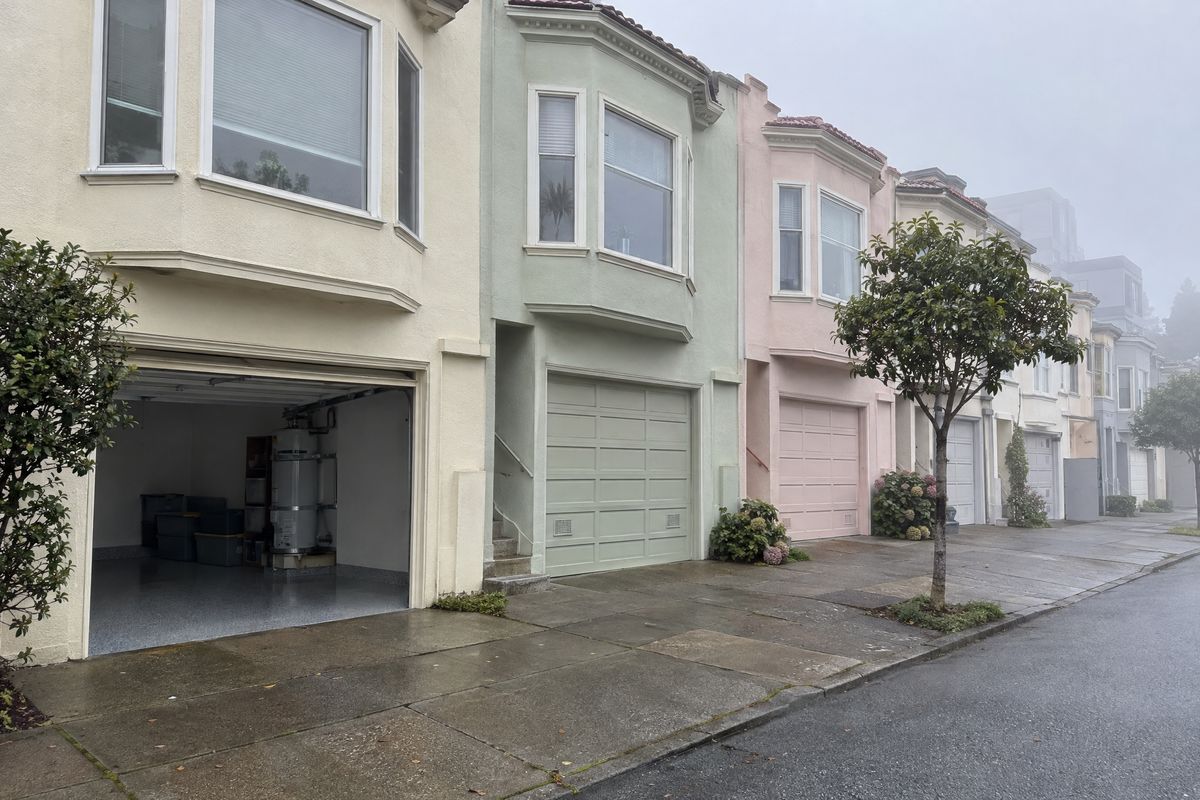
An epoxy floor in Bayview-Hunters Point often goes down on one of two kinds of slab, and the slab decides the job: the garage floor under an older house, or the ground floor of a production, distribution and repair (PDR) building. San Francisco's General Plan calls the area "a predominantly industrial and residential district," and the district's own area plan, the bulk of it adopted in 1995, says its older housing "generally consists of one-story dwellings over a garage." The same plan states that "Extensive landfill was carried out along the entire bay line with little regard for soil stability and toxicity." The work therefore starts with the concrete: how old it is, how much moisture rises through it, where it has cracked and whether it is still settling.
Each service below is set against those slabs, with the source named beside every figure. No published price survey covers this corner of San Francisco, so weigh a quote against the national price ranges rather than a local number. A request sent through this page is passed to an independent local installer with a California contractor license, and the quote and contract you receive are that installer's own. Look the license up on CSLB's site before signing; the license and contract checklist lists what else to confirm.
with requests passed to installers who hold California contractor licenses.
Free quote
Bayview-Hunters Point Houses, Bay Landfill and City Plans
SF Planning's 2012-2016 profile of Bayview Hunters Point gives its housing a median year built of 1962, and the Area Plan says "Approximately 43 percent of Bayview's housing stock was built prior to 1950." The India Basin historic context statement in SF Planning's archive traces India Basin's early homes to boatyard families' "simple frame vernacular dwellings," then to the U.S. Navy's purchase of the Hunters Point Shipyard in 1939, wartime "junior fives" along Innes Avenue and Ingalls Street, and "thousands of units of new public housing on Hunters Point ridge in the 1940s." The shipyard operated from 1939 to 1974, the City's cleanup overview says. Single-family houses were 63% of units in that profile, and SF Planning's 2025 Housing Inventory counts 13,616 units, 5,846 of them single-family and 5,735 in buildings of 20 or more; the San Francisco floor data page gathers the citywide counts.
Landfill shaped the shoreline here. The Area Plan says the Candlestick Point Perimeter area "was created by landfill prior to the development" and warns that, as a once-active heavy industrial area, it "could have toxic soil conditions on many developable sites." Open-File Report 2006-1037, which the U.S. Geological Survey prepared with the California Geological Survey (CGS), rates artificial fill laid over estuarine mud at the bay's edge "very high" for liquefaction and gives bay mud a moderate rating "due to high ground-water levels." Under the State's Seismic Hazards Mapping Act, CGS liquefaction zones "identify where the stability of foundation soils must be investigated," and the agency's EQ Zapp lookup shows whether an address lies in one. The shipyard went on the federal National Priorities List in 1989, and the Navy leads its cleanup.
Several plans overlap here. The bulk of the Bayview Hunters Point Area Plan was adopted on July 20, 1995 by Resolution No. 13917, with amendments in March 2006 and in 2010, and it leaves Hunters Point Shipyard to a plan of its own. In July 2008 the Board of Supervisors rezoned "a large portion of the industrial neighborhoods" into PDR districts. OCII, the City's Office of Community Investment and Infrastructure, describes Hunters Point Shipyard Phase 2 and Candlestick Point as "a 693-acre, master-planned, urban infill project" of about 10,672 new housing units, most of it still in pre-development. Permits fall under the 2025 San Francisco Building Code, where the City's own Chapters 1 and 1A take the place of the state residential code's first chapter, so the Department of Building Inspection is the office to ask whether your floor job needs a permit.
Industry and housing are the area's "dominant uses," in the Area Plan's words. Over a quarter of the land is industrial, with "over 1,000 establishments" and "almost 15,000 jobs" in buildings "rarely over three stories high," and the San Francisco Public Utilities Commission's Southeast Treatment Plant in the Bayview "treats 80 percent of the City's wastewater." For floors, that mix puts warehouse and shop slabs beside houses with garages, and near the water both kinds can sit on filled ground.
See Bayview-Hunters Point, San Francisco on Google Maps — requests from San Francisco reach independent installers who hold a California contractor license.
Garage and Home Floors in Bayview-Hunters Point
The home services here start from the garage slab and the ground-floor room. The Area Plan says "Most residential areas in Bayview Hunters Point are zoned for single-family and two-unit homes," and SF Planning's 2012-2016 profile counts 16,810 vehicles available, with 19% of households having none. Ground floors turned into living space are part of the picture too: SF Planning's accessory dwelling unit (ADU) page notes that "Many ADUs are converted from existing storage or garage space."
Garage Floor Epoxy Under a Bayview-Hunters Point House
Garage floor epoxy, a two-part resin cured into a hard film over ground concrete, depends here on a slab that is often decades old. Stonhard, a resin floor maker, warns that with slabs "over 25 years old, there is a risk that a moisture barrier was not installed," and says the ground beneath a slab "is almost always damp with a relative humidity of 100%." So the moisture test comes first, on fill or on the ridge. Sherwin-Williams' surface preparation guide, Form G-1 (revised 02/26), accepts in-slab probe readings of 80% or lower by ASTM F2170 and a calcium chloride result by ASTM F1869 of "not more than 3 pounds of moisture per 1,000 square feet per 24 hours"; Sika's Sikafloor-264 sheet allows up to 85%. The limit that counts is the one printed for the product on your quote.
Profile and price follow from the slab. Concrete surface profile (CSP), the roughness a coating grips, is graded 1 to 10 under the International Concrete Repair Institute's guideline. Sherwin-Williams says acid etching "tends to produce a CSP-1 to CSP-2 profile, which is suitable only for very thin systems," while Form G-1 lists CSP 5, the grade ICRI's guideline pictures as a medium shotblast, for its decorative flake systems. For price, one-car garages run $1,200 to $3,900 installed in HomeGuide's national survey dated February 3, 2026, on 288 to 392 square feet, and no survey publishes a figure for this neighborhood.
Polyaspartic Coatings for a Garage in Daily Use
A polyaspartic floor coating can take foot traffic within hours of the last coat, so it suits a garage that cannot sit empty for days. Laticrete's Spartacote Flex Pure sheet prints "Walk-on in 3-4 hours" and a "24-hour return to service," and Laticrete states those times for 70 degrees F and 50% relative humidity. NOAA's 1991-2020 normals give the San Francisco Downtown station an annual mean of 57.7 degrees F; that is outdoor air downtown, not a Bayview slab reading, and the sheet adds that "Changes in ambient conditions may cause times to vary." Laticrete's solvent-based Spartacote Flex SB asks for a drier slab: its sheet says "The RH of the slab must not exceed 75% as tested per ASTM F2170," where Form G-1 allows 80%, and Laticrete warns that polyaspartics "will not breathe."
Bay Area rules hold a floor coating to 100 grams of VOC, or volatile organic compounds, in each liter: the Air District set that figure in Regulation 8, Rule 3, in a table that took effect on January 1, 2011. Flex Pure's sheet prints "<100 g/L (as intended for use)"; a sheet that prints only a higher ceiling, such as the "<450 g/L" on Flex SB's, does not show that the product fits under the Bay Area line. Ask for each coat's VOC figure in writing.
Metallic Epoxy in a Converted Ground-Floor Room
A metallic epoxy floor, a clear resin coat whose metallic pigment spreads into a pattern during cure, suits a garage turned into a room. SF Planning's ADU page describes Junior ADUs that "convert up to 500 square feet of space in a single-family structure," but it also says "an ADU may not remove housing services, which includes garage, laundry room, storage space, etc.," so settle the plan with SF Planning, and the permit with the Department of Building Inspection, before choosing a floor. An old garage slab shows through this finish. Sherwin-Williams calls its Resuflor Topcoat Metallic II "a smooth system - substrate imperfections must be corrected or they can reflect through the system," and warns it "may fisheye if oil, silicones, mold release agents or other contaminants" are present; Laticrete says "Mock-ups and field test areas are required."
Stained Concrete on Old Bayview Slabs
Stained concrete keeps an old slab in view. By the Air District's definition, a stain is made "to change the color of a surface but not conceal the grain pattern or texture," so patches, cracks and saw cuts stay part of the floor. A slab over damp ground can also bloom white: Euclid Chemical says efflorescence appears when water moving through concrete "picks up free salts and other soluble materials and deposits them on the surface," and it traces secondary efflorescence to water arriving "after rain, from irrigation, or the surrounding soils." The Air District's VOC ceilings are 250 grams per liter for stains and 100 for concrete and masonry sealers. HomeGuide's staining survey, dated February 3, 2026, gives $3 to $15 per square foot nationally for staining concrete already in place.
Commercial Floors in Bayview's PDR Districts
Since the 2008 rezoning, much of the industrial land here is zoned PDR. Planning Code section 210.3 says businesses in PDR districts "generally share a need for flexible operating space" with "floors capable of bearing heavy loads," and the Area Plan says the shipyard, "Occupying over 500 acres," "was the single largest industrial area in the district." The slabs in question sit in low buildings, and near the bay they can stand on the filled land described above.
Commercial Epoxy Flooring for PDR Shops and Warehouses
Commercial epoxy flooring for a PDR shop is chosen by what rolls over it and what spills on it. Sherwin-Williams says "Use of steel wheeled vehicles versus rubber wheeled vehicles affects the choice of aggregate, chemistry, and application method," and "In general, the thicker the system, the better the chemical resistance." Where acids and solvents are handled, Dur-A-Flex's sheet of 8/8/2012 describes its Dur-A-Glaze Novolac Epoxy topcoat as giving "protection against chemicals, acids, solvents, and high temperatures," with "Secondary Containment" and "Battery Storage" among its uses, and gives "Full Cure Time (full chemical resistance) 7 days @ 70 degrees F."
The Air District's industrial maintenance category covers high-performance coatings formulated for floors facing extreme conditions such as "Immersion in water, wastewater, or chemical solutions" or "Frequent heavy abrasion," and labeled for them. Its limit is 250 grams of VOC per liter, where a general floor coating gets 100, and if a product is recommended for several categories, section 8-3-302.2 says, subject to the exceptions it lists, that "the most restrictive limit shall apply." Aisle lines answer to federal OSHA's 29 CFR 1910.176(a), "Permanent aisles and passageways shall be appropriately marked"; a separate OSHA letter of May 15, 1972, interpreting 29 CFR 1910.22(b), accepted lines of any color that "clearly define the area considered as aisle space" and "any width 2 inches or more." HomeAdvisor's June 2026 national page prices commercial and industrial coatings at "$12 or more per square foot."
Restaurant Kitchen Floors and Damp-Slab Limits
Commercial kitchen flooring answers to the California Retail Food Code wherever the kitchen sits. Health and Safety Code section 114268 wants floors where food is prepared to be "smooth and of durable construction and nonabsorbent material that is easily cleanable," coved "with a 3/8 inch minimum radius coving" that rises "at least 4 inches" up the wall, and section 114269 requires floor drains in water-flushed floors, sloped "1:50 to the floor drains," whenever a kitchen is newly built or extensively remodeled. The City's health department asks for something more in its construction guideline: "Submit physical finish samples for review and approval."
On a slab that tests damp, two urethane cement sheets allow more moisture than the resin-floor limits above. Dur-A-Flex's Poly-Crete HF sheet (6/18/2013) says it "Can be installed with moisture levels up to 20 lbs/1,000 sf/24 hrs," against the 3 pounds in Form G-1, and Sika's Sikafloor 22NA PurCem sheet accepts concrete "where <100% relative humidity is measured as per ASTM F2170." The same Dur-A-Flex sheet puts the usual build at 1/4 to 3/8 inch and the service range between -100 and 220 degrees F, adding that "Repeated exposure to hot oil or steam does not cause pitting, cracking or crazing."
Polished Concrete in Low-Rise Industrial Buildings
Polished concrete makes an existing shop or warehouse slab the finished floor by grinding, densifying and honing it rather than coating it. The Area Plan describes buildings "rarely over three stories high," and the joint ACI-ASCC specification, ACI SPEC-310.1-20, covers both "slabs-on-ground and suspended slabs." Hardness sets the limit: the Concrete Polishing Council's position statement on weak surfaces quotes that specification's requirement, "Mohs Hardness measured on slab surface is greater than 4," and names a densifier, a silicate that hardens the surface, as one remedy.
Grinding a slab indoors puts silica dust in the air, and the controls for it are set by Cal/OSHA in Title 8, section 1532.3. Its Table 1 row for walk-behind floor grinders calls for a water-fed machine or a dust collector whose filter reaches "99% or greater efficiency," and indoors a HEPA-filtered vacuum "to remove loose dust in between passes." Floor size moves the price: in HomeGuide's national polishing survey of February 8, 2026, spaces over 5,000 square feet "may drop to $3 to $6 per square foot."
Concrete Resurfacing Where Slabs Sit on Bay Fill
Concrete resurfacing, a new cement wearing surface on a worn slab, depends on a slab that has stopped moving, and the filled shoreline is where that question comes first. Wolverine Coatings' preparation bulletin says "A slab that is crumbling, rocking back and forth, heaving, or sinking is an unlikely candidate for coating without repair." An American Concrete Institute FAQ calls for a condition evaluation of the slab before an overlay is chosen and says "Any active cracks need to be stabilized to avoid being reflected through the topping"; in the International Concrete Repair Institute's repair terminology, an active crack is any crack "still moving."
Where a slab has sunk, the costs change. HomeGuide's resurfacing survey, dated February 3, 2026, gives national figures for that work as well: a structural engineer, at $100 to $200 hourly; mudjacking the slab, $3 to $6 per square foot; foam leveling, $5 to $25 per square foot; and the resurfacing itself, $3 to $7 per square foot. The Dogpatch and Potrero Hill page describes the filled ground of the old Mission Bay shoreline.
Hiring for a Floor Job in Bayview-Hunters Point
A floor job in California needs a contractor license once it passes a small threshold. CSLB's applicant page says a license is required "if the project requires a building permit or uses any additional workers," or when "the total cost (labor and materials) of one or more contracts on the project is $1,000 or more," and the one-car epoxy garage in HomeGuide's February 3, 2026 survey starts above it, at $1,200. A home contract over $500 also falls under section 7159 of the Business and Professions Code. CSLB's marketplace fact sheet tells customers of referral services to "enter into a contract directly" with the contractor, which is how a request from this page works; the guide to hiring a floor installer covers each step.
- Look up the installer's license on CSLB's online License Check and note its classification; under section 7030.5 the same number must appear on the contract.
- Check that the home contract names the contractor with business address and license number, states the price and describes the significant materials, as section 7159 requires; ask for each coat and its thickness in mils there.
- Under section 7159.5 the down payment can be no more than $1,000 or a tenth of the contract amount, whichever is lower; keep later payments behind the work done.
- Keep the cancellation notice: where section 7159 requires one, it gives three business days to cancel, or five for a senior citizen.
- Ask the Department of Building Inspection about permits, and on Hunters Point Shipyard or Candlestick Point land ask OCII which redevelopment rules apply.
- Get each coat's VOC content in grams per liter in writing; the Air District's ceiling is 100 for a floor coating and 250 for an industrial maintenance coating.
- Have ready the floor's size, what drives or stands on it, past spills and oil, cracks or sunken spots, and the days the space can stay empty.
Bayview-Hunters Point FAQs
What do garage floor coatings cost in Bayview-Hunters Point?
No price survey covers Bayview-Hunters Point, so the figures to use are national. HomeGuide's survey dated February 3, 2026 prices two-car garages, 400 to 576 square feet in its table, from $1,600 to $5,800 installed. Repairs and tests can come on top: HomeGuide's polyaspartic page of November 18, 2024 says extensive repairs or resurfacing could add $1 to $5 per square foot and puts moisture and hardness tests at $50 to $300. The cost tables have the rest.
Can you put epoxy on a garage slab built on bay fill?
A coating can go on such a slab once it passes the moisture test the product's sheet names and shows no movement. The fill is not the test by itself; Sika calls moisture vapor emission "a natural constituent of any concrete slab," so the reading decides. Where readings run high, makers sell moisture-mitigating primers with stated ceilings: Sherwin-Williams rates its Resuprime MVB at up to 85% relative humidity at 12 mils and 100% at 17 mils, on concrete at least 28 days old, and says not to apply it "over a slab while experiencing hydraulic pressure." Cracks that keep opening need repair first.
Is a permit needed to coat a floor in Bayview-Hunters Point?
Ask the Department of Building Inspection, because San Francisco's own Building Code, not the State's list, decides it. In San Francisco's 2025 Building Code, the City's Chapters 1 and 1A stand in for the administration chapter of the state residential code. That state chapter, in California Residential Code section R105.2, exempts "Painting, papering, tiling, carpeting, cabinets, counter tops and similar finish work," but the City has set its own administration text in its place. A permit also changes the license rule: CSLB says a job that requires any permit requires a license, whatever its price.
What VOC limit applies to a floor coating in a Bayview warehouse?
It depends on the category the product is made and labeled for. The Air District lets a floor coating carry 100 grams of VOC per liter, while an industrial maintenance coating, labeled for floors facing extreme conditions such as chemical immersion or heavy abrasion, may carry 250. A coating that is legal nationwide can still exceed the Bay Area figure, because the federal table in 40 CFR Part 59 Subpart D lets floor coatings reach 400 g/L. The Air District's September 1, 2011 compliance advisory puts it plainly: coatings manufactured after the effective dates "must meet the VOC limits below to be sold in the District."
Can I epoxy my garage floor myself?
You can buy a kit, but the kit makers set limits that an old Bayview slab may not meet. Rust-Oleum's EpoxyShield water-based kit sheet says it "is not intended for use on unsound previous coatings or floors that have a moisture problem," and Stonhard says "DIY epoxy kits are made for light-duty spaces like home garages or basements." HomeGuide's February 2026 national survey prices premade kits at $200 to $700. Whoever does the work, test the slab for moisture and grind it to the profile the sheet asks for.
Request a Floor Quote for Bayview-Hunters Point
Free quote