San Francisco Epoxy Floors Co.
(415) 801-3047Floor coatings and the rules for San Bruno, in San Mateo County.
Epoxy and Concrete Floors in San Bruno, CA
An epoxy floor in San Bruno is a two-part resin film laid on concrete that has been ground and tested, and three local facts shape the job: the age of the slab, the cool outdoor air NOAA records at San Francisco International Airport (SFO), which San Mateo County's Local Agency Formation Commission (LAFCo) places to the east of the city, and San Bruno's own building code. On age, the U.S. Census Bureau's American Community Survey for 2020-2024 gives a median year built of 1962 for the city's housing (table B25035), and its count by decade (table B25034) puts 4,811 of San Bruno's 16,433 housing units in the 1950s, the top decade in that count.
Send a floor request from this page and one independent installer in the area receives it. Look up that installer's California contractor license on CSLB's License Check before signing anything; the written quote, the contract and the work all come from the installer, not from this site. National survey prices are collected on the floor cost page; none of those surveys prints a price for San Bruno itself.
with requests passed to installers who hold California contractor licenses.
Free quote
San Bruno's Post-War Houses, Hills, Airport Air and Building Code
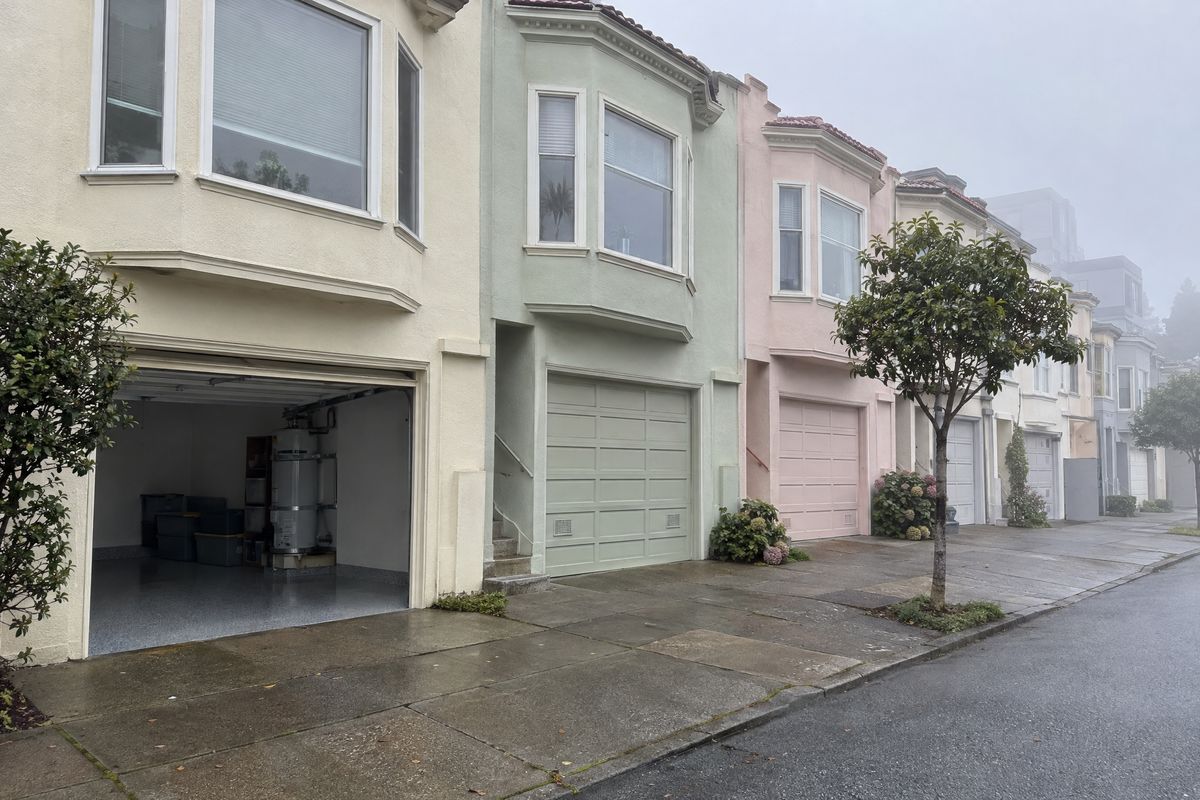
San Bruno was built out in two waves. The City says the San Bruno Park Addition was developed into housing after the 1906 earthquake and fire, and that the town had roughly 1,400 residents when it incorporated on December 23, 1914. The larger wave followed World War II, when houses were built "for the vast number of support personnel and veterans returning from the war" and, after the Mills Park Addition, "the land in the western hills of San Bruno was also developed into housing." The City's history counts a town of about 6,500 in 1940 and over 35,000 people by the mid-1960s, then adds: "Since then the population has stabilized due to a lack of available land." The Census decade count shows the same pattern, with 672 units built from 2010 to 2019 and 177 since 2020.
Detached houses make up most of that stock. Census table B25024 counts 9,501 single-family detached units and 520 attached ones, and LAFCo's 2024 Municipal Service Review calls the city "primarily a low-density residential community" of a little more than 6 square miles, with residential uses on 53% of its land. Most of the remainder is in multi-unit buildings, including 2,216 units in buildings of 50 or more; the Review places "high-density residential housing" near the central business district, offices and commercial areas, and describes The Crossing as "a transit-oriented mixed-use development" on the former naval base. Census QuickFacts gives an owner-occupied rate of 62.1% and a median owner-occupied value of $1,207,500 for 2020-2024.
The climate figures on this page come from NOAA's airport station (USW00023234), which measures the airport's outdoor air, not a San Bruno garage. Its 1991-2020 normals give an annual mean of 58.7 degrees F, 19.64 inches of precipitation, 39.4 days a year with 0.10 inch or more, 4.2 days a year at the 90 degrees F threshold and 0.2 days at the 32 degrees F threshold; the monthly tables are on the floor data page. The National Park Service describes Sweeney Ridge as "a hilly hiking area of ridges and ravines between San Bruno and Pacifica," the coastal city covered on the Pacifica floor page.
San Bruno writes its own building rules, apart from San Francisco's. Its Municipal Code adopts the 2025 California Building Code, with the 2025 California Historical Code and the 1997 Uniform Housing Code, in section 11.04.010, and the 2025 California Residential Code in section 11.10.010. The local residential amendments in section 11.10.020 amend sections R308.1, R319.7.1 and R902.1.2, add section R341, and contain no amendment to section R105.2, the State's list of work exempt from permit. The City's Building Division "issues building permits and takes in plans for review" and lists a handout titled 2022 Permits Exempt, so it is the office that rules on a floor job; the installer hiring guide explains why, below $1,000, its answer also bears on whether a license is required.
Commercial, auto, office and industrial uses make up 10% of the city's land use in the LAFCo Review, and the City's history notes that Mills Field was dedicated in 1927 near the site SFO occupies now. CDTFA's rate table, operative October 1, 2026, lists 9.875% for the City of San Bruno, above the 7.25% statewide base. CDTFA's Publication 9 says "Construction contractors are generally the consumers of materials"; ask that the quote show how tax is figured on your job, and take any doubt to CDTFA or a tax adviser.
See San Bruno, CA on Google Maps — requests from San Francisco reach independent installers who hold a California contractor license.
Floor Coatings for San Bruno Garages, Rooms and Patios
Home floor jobs in San Bruno start from the slab of a house: a garage, a room converted from one, or a patio. Which moisture test a careful installer runs depends on what the chosen coating's data sheet asks for. The calcium chloride dome of ASTM F1869 gives an emission rate, written as pounds over 1,000 square feet in a 24-hour period; the probes of ASTM F2170 sit in drilled holes and read the slab's own relative humidity; the taped plastic sheet of ASTM D4263 is a yes-or-no check for moving moisture. ASTM F710, written for resilient flooring, requires a vapor retarder under on- or below-grade slabs, and Stonhard warns that a slab over 25 years old may lack one.
Garage Floor Epoxy on San Bruno's Post-War Slabs
Garage floor epoxy reaches traffic strength on a schedule its data sheet ties to temperature, and the airport station's normals show how slow that schedule can run in winter. Sika's Sikafloor-264 data sheet (September 2026) will not go down in air below 50 degrees F, and its cure table stretches as the room cools: for foot traffic, light traffic and full cure it prints "~ 24 hours ~ 3 days ~ 10 days" at 50 degrees F and "~ 12 hours ~ 2 days ~ 7 days" at 68 degrees F. At the airport station the normal daily low stays under 50 degrees F from November through April, down to 44.5 degrees F in January. Those are outdoor air figures, not garage readings, so ask for the slab temperature to be measured on the day.
Preparation is the other half of the job. Wolverine Coatings' bulletin says the top skin of finished concrete, called laitance, is its weakest layer and that a coating's bond cannot be stronger than the surface under it. Sherwin-Williams adds that acid etching "tends to produce a CSP-1 to CSP-2 profile, which is suitable only for very thin systems," while its Form G-1 lists its decorative flake systems at CSP 5, the profile ICRI's guideline pictures as a medium shotblast. For price, HomeGuide's February 2026 national survey says "An epoxy floor costs $1,600 to $5,800 for a 2-car garage."
Polyaspartic Coatings and the Airport Station's Cool Nights
Polyaspartic floor coating suits a San Bruno owner who wants the garage back fast, and it tolerates cooler air than the epoxy in the same maker's table. Citadel's comparison gives its polyaspartic grout coat an application range of "0 degrees F - 90 degrees F+" and its epoxy "> 50 degrees F," and puts the polyaspartic's full return to service at 24 hours where the epoxy needs 36 to 48 hours, both figures flagged as ambient dependent. Laticrete's TDS 432 chip guideline asks for 24 hours out of service before its polyaspartic chip floor returns to normal use. The surveys price that speed: HomeGuide's November 2024 polyaspartic page prices it at $5 to $12 a square foot installed, and the same page's epoxy column reads $4 to $10.
Humidity sets the other limit. Citadel's RG-80X topcoat sheet (CDL-10) asks that "the surface temperature is at least 5 degrees F (3 degrees C) above the dew point and RH less than 75%," and its Polyurea-350 base coat sheet (CDL-11) says "The relative humidity of the air should not be greater than 85%." Outdoor temperature normals say nothing about a garage's dew point on the day, so the reading that decides is the one taken in the garage that morning. For floor coatings, Regulation 8, Rule 3 of the Air District sets 100 g/L in its July 1, 2009 text, so ask which product on the contract meets it.
Metallic Epoxy for Converted Rooms in San Bruno Houses
Metallic epoxy is a clear resin carrying metallic pigment, laid as a smooth top layer, so the slab beneath has to be right first. Laticrete's pigment sheet, DS-85.7-0819, calls its pigments "aluminum platelets coated with metal oxides," mixed into a clear epoxy or polyaspartic resin at 8 fl.oz. per mixed gallon, and says "Mock-ups and field test areas are required." Sherwin-Williams lays its metallic coat on a colored base coat, noting that the base color "will influence the overall appearance of the floor," and warns that "substrate imperfections must be corrected or they can reflect through the system." On a 1950s garage slab with patched cracks, that warning is the reason to see a test area on your own floor before the full pour.
If the metallic coat is going into a garage that is becoming a room, the conversion is the permit question, and in San Bruno it belongs to the City's Building Division. San Francisco Planning's ADU program applies inside San Francisco and has no say over a San Bruno house. CSLB's bulletin #24-07 adds a license point: if the work "is subject to a permit requirement of any kind," a license is required, whatever the contract price.
Stained Concrete on San Bruno Patios and Interior Slabs
Stained concrete colors the slab instead of covering it, so the slab's history stays in view. In Regulation 8, Rule 3, a stain is a coating "labeled and formulated to change the color of a surface" "but not conceal the grain pattern or texture," and the rule's Table 2 allows stains 250 g/L of VOC and concrete and masonry sealers 100 g/L. Outdoors, the sealer is the part that wears. HomeGuide's February 2026 staining survey says "Stained concrete should be sealed every 1 to 3 years" and prices staining an existing slab from $3 to $15 per square foot, nationally.
Rain is the patio's other test: at the airport station to the east, NOAA's monthly precipitation normals, in inches, are 4.14 for December, 3.89 for January and 3.96 for February, against 0.00 for July. Euclid Chemical says secondary efflorescence, salt carried up and left on the surface, "is caused primarily by water that travels through the concrete after rain, from irrigation, or the surrounding soils," so a patio that stays wet through the winter is the one to moisture-test before it is stained and sealed.
Commercial Floors in San Bruno: Shops, Offices and Kitchens
A business floor in San Bruno answers to rules that follow it across California and the Bay Area, from the Retail Food Code to Cal/OSHA's silica standard and the Air District's coating limits, plus San Bruno's own building code for permits. That code carries the airport into its text: among the City's amendments to the 2025 California Building Code in section 11.04.020 is section 107.6, headed "Protection from Airport Noise."
Commercial Epoxy for San Bruno Shops, Offices and Auto Bays
Commercial epoxy flooring is specified by what the floor has to take, and the Bay Area rule sorts the products the same way. Regulation 8, Rule 3 allows 250 grams of VOC per liter for an industrial maintenance coating, a category the Air District defines by extreme conditions such as immersion, corrosive agents, temperatures above 250 degrees F or "Frequent heavy abrasion," against 100 grams for an ordinary floor coating. When one product is recommended for two or more categories, section 8-3-302.2 says, with listed exceptions, "the most restrictive limit shall apply."
In an auto bay or a stockroom, the slab must also be strong enough to hold the coating. Sika's surface preparation guide asks for concrete of at least 3626 psi in compression with a pull-off strength of 218 psi, prepared to CSP-3 to CSP-5 by shot blasting or an equal mechanical method. Federal OSHA's 29 CFR 1910.176(a) says "Permanent aisles and passageways shall be appropriately marked," and 29 CFR 1910.144 makes yellow the basic color for marking physical hazards, so the striping belongs in the floor specification from the start.
Restaurant Kitchen Floors in San Bruno Food Facilities
Commercial kitchen flooring in San Bruno follows the California Retail Food Code, a State law that reads the same here as anywhere in California. Health and Safety Code section 114268 calls for floors coved at the wall "with a 3/8 inch minimum radius coving" that extends at least 4 inches up, and section 114269 requires floor drains, with the floor sloped 1:50 to them, in floors that are water-flushed for cleaning, upon new construction or extensive remodeling. San Francisco's health department guide for building food facilities covers San Francisco only, so ask San Bruno's Building Division where a food facility's plans and finish samples are reviewed.
Urethane cement is what resin makers offer for kitchens that take hot washdowns. Dur-A-Flex's sheet for Poly-Crete HF (June 2013) says "It is typically applied 1/4 -3/8 inch thick depending on design requirements," rates it for service from 100 degrees F below zero up to 220 degrees F with live steam, and prints "Light Traffic 6-8 hours" and "Full Service 3 - 5 days." For application, the sheet prefers 50 to 85 degrees F. Sika's sheet for Sikafloor 22NA PurCem sets an ambient humidity window of 30% to 85% during application and curing, so the kitchen's air is read along with the slab.
Polished Concrete for San Bruno Offices and Storefronts
Polished concrete leaves no film on the floor; abrasives cut the shine into the concrete, so the slab's hardness and soundness decide whether it can be done. The ASCC Concrete Polishing Council's glossary sorts the work by abrasive: grinding at 100 grit or lower, honing from 100 to 400 grit and polishing at 800 grit or higher, and its Position Statement #7, on weak surfaces, cites ACI 310.1-20's call for a Mohs hardness greater than 4 on the slab, a test worth asking for on concrete poured with a 1950s San Bruno house.
Respirable silica from that grinding falls under Cal/OSHA's Title 8, section 1532.3. For a walk-behind floor grinder, its Table 1 offers a machine with an "integrated water delivery system that continuously feeds water to the cutting surface" or one with a dust collector having "a filter with 99% or greater efficiency and a filter-cleaning mechanism," and indoors adds: "use a HEPA-filtered vacuum to remove loose dust in between passes." HomeGuide's February 2026 polished concrete page shows the rate per square foot falling as the floor grows: often $8 to $15 or more below 1,000 square feet, and possibly $3 to $6 above 5,000 square feet, against $3 to $12 for basic finishes overall, all national figures. For upkeep, the 2009 Concrete International article hosted by ASCC calls for "daily dust mopping" and warns, "Avoid cleaners that are highly alkaline or acidic as these will quickly dull a polished floor."
Concrete Resurfacing for Worn and Cracked San Bruno Slabs
Concrete resurfacing lays a new cement wearing surface on a floor slab that is worn but no longer moving, and the first step is telling those apart. In the International Concrete Repair Institute's terminology, a dormant crack is "any crack not likely to become active in the future" and an active crack is "any crack that is still moving." NRMCA's CIP 4 says most random cracks that appear at an early age "rarely affect the structural integrity or the service life of concrete," while ACI says cracks "may point to problems of greater magnitude." HomeGuide's February 2026 page says "Concrete resurfacing costs $3 to $7 per square foot" nationally, and that cracks wider than 1/4 inch typically indicate foundation problems.
In the western hills the City says were built out after the war, slope adds a question a flat lot does not raise. The California Geological Survey draws landslide zones that "identify where the stability of hillslopes must be evaluated," and its EQ Zapp address lookup shows whether a lot falls inside one. A slab that has dropped or tilted on a hillside lot is a structural question before it is a resurfacing job; HomeGuide's February 2026 resurfacing survey gives structural engineers' rates as $100 to $200 per hour, nationally.
Hiring a Floor Installer in San Bruno: License, Contract, Permit
A floor job in San Bruno runs under State contractor law, the Bay Area air rule and San Bruno's own building code, not San Francisco's. The license test comes first. Since January 1, 2025, CSLB's bulletin #24-07 explains, the exemption for minor work covers only jobs under $1,000, and even below that a license is required if the work needs a permit of any kind or the unlicensed person hires help. Section 7048(b) also bars dividing one job into smaller contracts to stay under the limit. The short list below fits a San Bruno address; the guide to hiring an installer quotes the statutes in full.
- Look up the installer's license number on CSLB's License Check before you sign, and match it to the number section 7030.5 requires on every contract and advertisement.
- Expect a written contract headed Home Improvement that gives the contractor's license number, the Contract Price, and a description of the project and the significant materials, as section 7159 requires.
- Cap the down payment at the lesser of $1,000 and a tenth of the price (section 7159.5), and do not let later payments run ahead of the work done.
- Unless negotiated at the contractor's place of business, the section 7159 notice gives you three business days to cancel (five for a buyer 65 or older, a senior citizen under Civil Code section 1689.5); since January 1, 2026 you may cancel by email.
- Ask San Bruno's Building Division whether the job needs a permit; the State's exempt list in section R105.2 names painting, tiling, carpeting and similar finish work, and San Bruno's residential amendments in section 11.10.020 leave that list unchanged.
- Ask which products on the contract meet the Air District's 100 g/L limit for floor coatings, or 250 g/L where a product qualifies as an industrial maintenance coating, in its rule text dated July 1, 2009.
- Have ready for the quote: the floor's size, its age if known, photos, any old coating or damp marks, and when you need the space back.
San Bruno FAQs
What does garage floor epoxy cost in San Bruno?
No price survey publishes a figure for San Bruno, so the national surveys are the only published guide. HomeGuide's February 2026 page says "An epoxy floor costs $1,600 to $5,800 for a 2-car garage," and its 1-car row, for garages of 288 to 392 square feet, reads $1,200 to $3,900 installed. HomeGuide's December 2024 garage coating page adds that "Labor often makes up about 50% to 70% of the total project cost." The installer's written quote for your slab, after the moisture test, is the figure that counts.
Does San Bruno require a permit for a garage floor coating?
San Bruno's Building Division answers that for a given job, and this page cannot answer it for you. The City's code adopts the 2025 California Residential Code, whose section R105.2 includes "Painting, papering, tiling, carpeting, cabinets, counter tops and similar finish work" in its list of work for which "Permits shall not be required," and San Bruno's amendments in section 11.10.020 do not change that section. Whether the Division treats a coating as similar finish work, and whether the rest of the job needs a permit, is its call.
Can you put epoxy on a damp garage slab?
Not until a test shows the slab is inside the product's limit. Sherwin-Williams' Form G-1 wants a calcium chloride result of "not more than 3 pounds of moisture per 1,000 square feet per 24 hours" and probe readings of 80% or lower, and Sika's Sikafloor-264 sheet allows up to 85% by probe. ASTM F1869 itself says its rate "only reflects the condition of the concrete floor at the time of the test," so a 1962 slab needs the reading as much as a new one. Above the limits, makers sell moisture-mitigating primers rated by the same probe test.
How long after a new garage floor can I park in San Bruno?
It depends on the product and on the slab's temperature. Rust-Oleum's EpoxyShield sheet ESH-06 prints "Vehicle Traffic: 4 days" for its 70-80 degrees F, 50% humidity test conditions, warmer than every monthly mean of the airport station's outdoor air, where September's 65.3 degrees F is the highest. HomeGuide's February 2026 survey says "don't walk on it for 16 to 24 hours or drive on it for 2 to 7 days." Citadel's RG-80X polyaspartic topcoat sheet lists 24 hours for vehicle traffic. Ask for the vehicle time in writing at the temperature your garage will actually hold.
Does a garage floor job in San Bruno need a contractor's license?
Yes, once labor and materials total $1,000 or more. Below that, CSLB still requires a license when the job needs a permit or when the person doing it hires anyone, and section 7048(b) forbids splitting a job to stay under the line. The rule is the State's, so it applies in San Bruno exactly as it does in San Francisco. Confirm the license on CSLB's License Check. CSLB's marketplace fact sheet also advises customers to sign the contract with, and make payments to, the license holder directly, which is how a request from this site works.
Request a Floor Quote for San Bruno
Free quote