San Francisco Epoxy Floors Co.
(415) 801-3047Floor coatings and the rules for Richmond District, San Francisco.
Epoxy Floors in the Richmond District, San Francisco
A Richmond District floor job often sits in an older building of two to four units, so who signs the contract, what the moisture test reads and how much VOC the Bay Area Air District allows all come before the color; VOC means the volatile organic compounds that evaporate from a coating while it hardens. By the Table 28 counts in SF Planning's 2025 Housing Inventory, the Inner Richmond and the Outer Richmond each have more housing units in buildings of two to four units than in single-family houses, and an outreach board for SF Planning's Richmond District Strategy reads "66% Renters." Underneath lies the former dune sand that SF Planning's residence parks context statement describes, and overhead the cooler air the National Weather Service assigns to the ocean side.
Fill in the form here and the request is handed to a local installer, independent of the site, who holds a California contractor license; that person quotes the job, signs the contract with you and does the work; before signing, owners and tenants alike can look the license up on the Contractors State License Board (CSLB) site. Every published price is a national survey figure, and the floor cost page sets each one beside its date. After a look at the Richmond's buildings, soil and zoning, each service follows, set against a Richmond slab, and the page ends with the hiring terms that matter where most residents rent.
with requests passed to installers who hold California contractor licenses.
Free quote
Richmond District flats, early transit lines, dune sand and zoning
The Richmond District was laid out decades before it filled in. SF Planning's Richmond District Strategy says it was named "for its resemblance to the sand dunes of Richmond, Australia," and SF Planning's residence parks context statement (October 2016) records that "the Richmond District was platted by 1870" but that "significant improvements and settlement wouldn't arrive for decades." Dairy farmhouses came first, and one pattern that followed was "single-family or two-flat residences built on an individual basis." Transit set the pace: by 1890 cable car tracks ran out Clay, California and Geary Streets "as far west as Presidio Avenue," and "In 1912, the city inaugurated the first San Francisco Municipal Railway line on Geary Street." The residence parks there date from 1906 to 1913, Jordan Park first and Sea Cliff and Lincoln Manor last, and after the 1906 earthquake, emergency housing "brought new residents."
Today units in two-to-four-unit buildings outnumber single-family houses in both halves of the district, going by Table 28 of SF Planning's 2025 Housing Inventory (April 2026): it counts 19,411 units in the Outer Richmond, 8,516 of them in buildings of two to four units against 5,129 single-family, and 10,028 in the Inner Richmond, where 4,822 sit in two-to-four-unit buildings and 1,350 are single-family. SF Planning's 2012-2016 profile of the Inner Richmond puts its median year built at 1959. The Richmond District Strategy says almost all parcels allow four-story buildings, "yet nearly 90 percent are only two stories or less," and a Strategy board says "54% of residential units in the Richmond are rent controlled." The Strategy's "Overview of the Neighborhood" outreach board reads "66% Renters" and "71% in Inner Richmond vs. 59% in Outer Richmond," figures that differ from the 68% renter-occupied in the 2012-2016 Inner Richmond profile.
The Richmond began on the same ground as the Sunset: SF Planning's residence parks context statement calls both districts former "vast foggy sand dunes," and the Richmond District Strategy says "Golden Gate Park, Lands End, Lincoln Park, and Ocean Beach surround District 1 on three sides." On summer mornings, the National Weather Service's 1995 climate memorandum finds "only partial clearing" on the ocean side. Stonhard, a resin floor maker, writes that even where the water table is not high, the ground under a slab is almost without exception "damp with a relative humidity of 100%." The California Geological Survey draws liquefaction zones, for ground where "loose, water-saturated sediments lose strength and fail during strong ground shaking," around "shallow historic groundwater (< 40 feet depth)" in uncompacted sands and silts laid down in the last 15,000 years; its EQ Zapp tool tells an owner whether an address lies inside one. The Sunset District page covers the dunes south of the park.
Zoning is the rule SF Planning's Richmond documents dwell on. The Richmond District Strategy says "The largest potential for new housing units exists in the RH-2 zoning district," which "allows two units, but on the majority of the parcels, only single-family homes have been built." The Family Zoning Plan, signed on December 12, 2025 and effective January 12, 2026, focuses on "the western and northern parts of San Francisco," and SF Planning's answer to owners is that "changes to existing buildings or demolition of existing buildings are not required when the zoning is updated." Adding a garage is its own review: SF Planning's "Guidelines for Adding Garages and Curb Cuts" (V. 09/01/2025) say a curb cut "should not exceed" the Public Works maximum of 10 feet, want a garage door "no larger than necessary," and state that "The addition of a new garage requires a new street tree."
The district's commerce runs along a few streets: SF Planning finds "Pockets of commercial and retail activity" along Geary Boulevard and on "the neighborhood commercial streets of Clement and Balboa Streets." Growth has been slow, "12% Growth Rate Since 1980 vs. 18% Citywide" by the Strategy's outreach board, and "Since 1990, the City has added over 44,000 units; only 1 percent of these were located in District 1." With so little new building, a Richmond floor job usually means an existing slab, and its age is the first thing to ask about.
See Richmond District, San Francisco on Google Maps — requests from San Francisco reach independent installers who hold a California contractor license.
Floor Coatings for Richmond District Flats, Garages and Rooms
The four home services meet a different stock here than in the Sunset. By the Table 28 counts, buildings of two to four units hold the largest share of housing units in both the Inner and the Outer Richmond, the Inner Richmond's median year built is 1959, and the person living on a floor is often not the one who owns it. That changes who signs more than it changes the chemistry: the district began as dune sand on the ocean side, so each service below starts from the test its data sheet names.
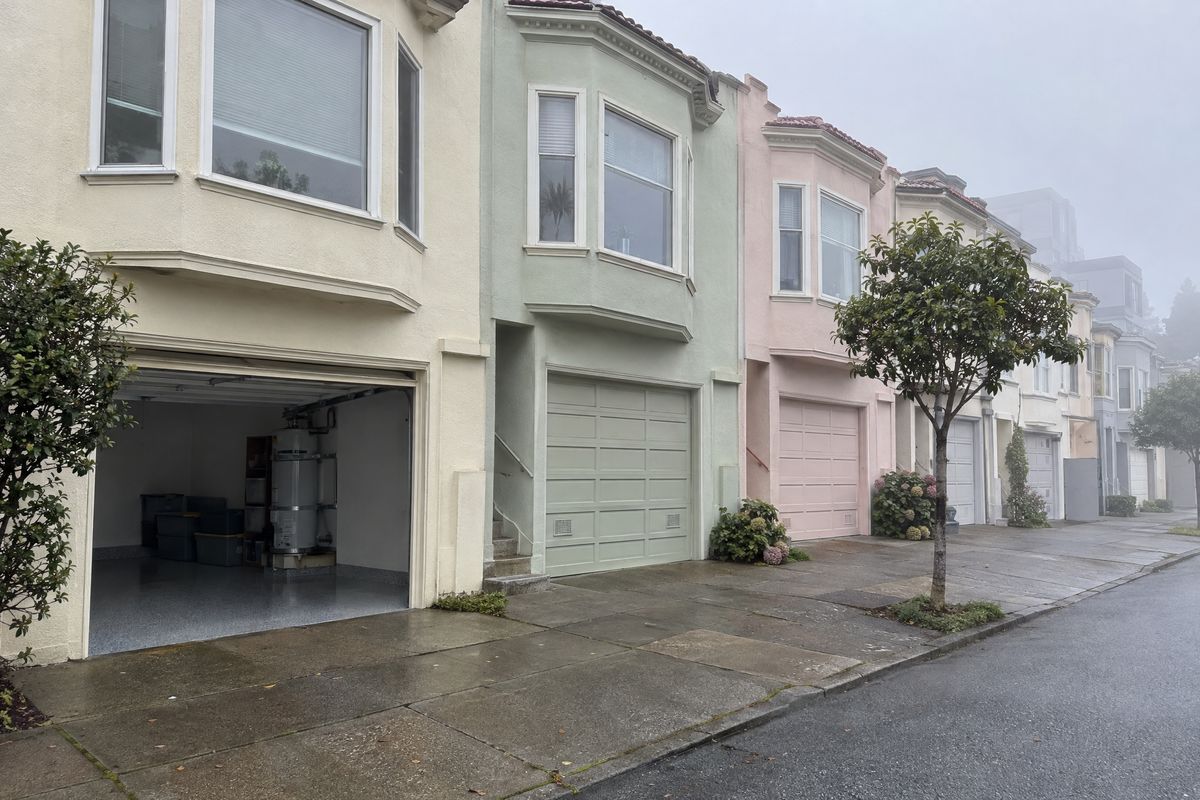
Garage floor epoxy in a Richmond District building
Garage floor epoxy in a Richmond building starts with a reading of the slab, and the in-situ probe test, ASTM F2170, reads relative humidity down inside the concrete rather than at its face. Wagner Meters, a probe maker, calls for "Three test holes for the first 1,000 ft2" and waits "24 hours before a documentable reading." Sherwin-Williams' Form G-1 accepts readings of "80% or lower" under its non-permeable floors, while Sika's Sikafloor-264 sheet (September 2026) allows up to 85% for that epoxy. Simiron's Polyaspartic HS sheet adds a caution for any test: "seasonal variations in ground moisture can cause excessive moisture vapor transmission (MVT) regardless of results measured prior to coating application."
Cool air sets the calendar after that. On the Sikafloor-264 sheet, foot traffic, light traffic and full cure take about 24 hours, 3 days and 10 days at 50 degrees F, and at 68 degrees F they shorten to about 12 hours, 2 days and 7 days. NOAA's San Francisco Downtown station records a 1991-2020 monthly mean of 52.2 degrees F in January rising to 62.9 degrees F in September; that is outdoor air downtown, not a reading from the Richmond or from inside a garage. Sika warns that "unvented heaters and certain heat sources may result in defects," so how a cold Richmond garage gets warmed is a question for the installer. The city's floor numbers list each month.
Polyaspartic floor coating in the Richmond's ocean-side humidity
Polyaspartic floor coating, the aliphatic polyurea class that cures in hours, draws its tightest lines at humidity and slab moisture, the two readings ocean-side air pushes on. Citadel's RG-80X topcoat (technical data CDL-10) needs the floor's surface to sit 5 degrees F above the dew point or warmer, the dew point being the surface temperature below which moisture beads out of the air, plus "RH less than 75%"; its Polyurea-350 base coat (CDL-11) allows air humidity up to 85%. Westcoat's EC-101 sheet says "High humidity will reduce the working time and dry time." Under the coat, Laticrete's Spartacote Flex SB holds the slab to 75% by ASTM F2170, below the 80% that Sherwin-Williams' Form G-1 accepts under non-permeable floors.
Speed counts for less where no car waits. SF Planning's 2012-2016 profile records 24% of Inner Richmond households with no vehicle; in a garage used for storage or a workshop, the 24-hour vehicle time on the Flex SB sheet weighs less than its moisture limit. Concrete Decor magazine adds that "This is not a do-it-yourself product."
Metallic epoxy for a Richmond ground-floor unit or shop
Metallic epoxy, in which metallic pigment spreads into a pattern as the resin cures, suits a ground floor becoming a room, a unit or a storefront, and in the Richmond the lot's unit count shapes that project. SF Planning's page on accessory dwelling units (ADUs) sets the number allowed in its Local program by the legal units already there: "4 or less legal dwelling units on the lot: 1 ADU + 1 Detached ADU allowed" and "5 or more legal dwelling units on the lot: unlimited ADUs + 1 Detached ADU allowed." The State program lists a "60-day review timeframe from date of complete application." The page also says "an ADU may not remove housing services, which includes garage, laundry room, storage space, etc.," a line to read early where 54% of residential units are rent controlled.
The coat itself is a mock-up job. Westcoat's Liquid Dazzle is "a 100% solids epoxy floor coating system" with additives that "create an evolving drift dynamic," and Laticrete doses its pigment at "8 fl.oz. per mixed gallon of resin," naming "Residential Garages" and "Retail & Shopping Malls" among the uses. Laticrete's line on samples is plain: "Mock-ups and field test areas are required." Ask to see the sample laid on the same base color the Richmond floor will get.
Stained concrete on older Richmond District slabs
Stained concrete shows the slab instead of hiding it. The Air District's Regulation 8, Rule 3 defines a stain as a coating made "to change the color of a surface but not conceal the grain pattern or texture," so patches, saw cuts and old repairs in a Richmond floor stay visible once it is colored. The Concrete Polishing Council's glossary, from ASCC, says a dye "penetrates into the concrete while it is in solution," and it can only color concrete it reaches. Sika's water drop test, ASTM F3191, reads a surface as "Porous/Absorptive" when a drop soaks in within a minute, and Sherwin-Williams' Form G-1 lists "oils, grease, wax, sealers, curing compounds" among what comes off before its resin floors.
The sealer carries the tighter Air District limit, 100 grams of VOC per liter for concrete and masonry sealers against 250 for stains. On price, HomeGuide's February 2026 staining survey gives a national band of $3 to $15 a square foot for an existing floor and $600 to $3,000 for 200 square feet, with the job taking "1 to 3 days." On a polished floor, its February 2026 polished concrete survey adds $1 to $3 a square foot for dyeing.
Shop, Restaurant and Older Slab Floors in the Richmond District
The Richmond's commercial floors sit in its retail pockets, which SF Planning's Richmond District Strategy places along Geary Boulevard and on Clement and Balboa Streets. They are storefronts, stockrooms and, for food businesses, kitchens in older buildings, so the four services below start from what an old slab can take: shop coatings under OSHA's walking-surface rules, kitchens under the City's health guide, polish on a slab hard enough to cut, and resurfacing where the top has worn through.
Commercial epoxy flooring for Geary and Clement storefronts
Commercial epoxy flooring in a Richmond storefront answers to federal OSHA's walking-surface rules as much as to the slab. 29 CFR 1910.22(a)(1) requires "All places of employment, passageways, storerooms, service rooms, and walking-working surfaces" to be kept clean, orderly and sanitary; 1910.176(a) says "Permanent aisles and passageways shall be appropriately marked"; and 1910.144 makes yellow "the basic color for designating caution." Thickness follows the job, in mils, thousandths of an inch: Wolverine Coatings matches "10 - 40 mils" of coating to a CSP 3 to 5 profile, CSP being the concrete surface profile, the roughness ground into a slab before coating. The Air District's 250-gram industrial maintenance limit is for coatings formulated and labeled for extreme conditions such as immersion, corrosive agents or heavy abrasion; an ordinary Clement Street shop floor coating is held to 100.
Restaurant kitchen floors along Clement Street and Geary
Commercial kitchen flooring in a Richmond restaurant is reviewed against the San Francisco Department of Public Health's "Construction Guideline for Retail Food Facilities," which applies the State's Retail Food Code locally and says "Submit physical finish samples for review and approval." The guide requires "A positive slope of 1:50" where floors have drains, measured "from wall to wall within the food preparation or utensil wash area," and rejects a dish around the drain, "a three to four diameter depression," as "not acceptable." Equipment empties "through an air gap into an open floor sink," and "Topset rubber base is not approved except in customer areas."
Urethane cement, a cement-filled polyurethane laid as a thick slurry, is what its makers sell for hot washdowns and thermal shock. In the 2.14.2018 edition of Sika's data sheet, Sikafloor 22NA PurCem typically builds a layer between 3/16 and 1/4 inch and serves from 212 degrees F down to -40 degrees F. Air humidity has to stay inside 30% to 85% through application and cure, and the slab may read anything under 100% relative humidity on the ASTM F2170 probe test described above.
Polished concrete in older Richmond storefronts
Polished concrete, a slab ground and honed until the concrete itself carries the shine, needs a surface hard enough to take the cut, so an older Richmond slab's hardness is the first question. The ASCC Concrete Polishing Council's Position Statement #7 (08/2023) quotes ACI 310.1-20 Section 3.1.4.1, "Mohs Hardness measured on slab surface is greater than 4," and names "Application of a densifier to increase the hardness of a concrete surface" as one remedy for a soft top.
The owner then picks two things: gloss, from Level 1 "Exposed/Flat (Ground)" to Level 4 "Highly Polished" on the Council's appearance chart, and stone exposure, from Class A cream to Class C full aggregate. On slip, measured as the dynamic coefficient of friction (DCOF) a wet floor gives, the Council's Position Statement #2 reports results that "significantly exceeded the required DCOF of 0.42, even at very high gloss levels." In HomeGuide's February 2026 national figures, the cream look runs $3 to $8 a square foot, the salt and pepper look $4 to $10.
Concrete resurfacing for worn Richmond District slabs
Concrete resurfacing on a Richmond floor means a new cement wearing course over a worn slab, and the first step is naming the wear. NRMCA's CIP 1 calls loose powder on hardened concrete "dusting or chalking," lists "Insufficient curing" among its causes, and starts the repair by removing "the weak surface layer." Scaling, in NRMCA's CIP 2, comes from "cycles of freezing and thawing," yet NOAA's 1991-2020 normals give the San Francisco Downtown station 0.0 days a year at the 32 degrees F threshold for the daily low (downtown air, not a Richmond reading), so a scaled-looking Richmond floor calls for a second look at its cause. Wolverine Coatings adds that "Surface deterioration is not necessarily an indicator of structurally unsound concrete."
Euclid's Euco Re-Cover lists "Garage floors" among its primary uses, goes from a featheredge, a thin tapered edge, to 3/8 inch, and takes rubber tires in 12 hours at 75 degrees F. HomeGuide's February 2026 survey gives resurfacing an average range of $300 to $700 per 100 square feet, national. Ask which product and thickness the quote names, since a home improvement contract has to describe the significant materials.
Hiring for a Floor in a Richmond District Building
California's home improvement rules reach renters as well as owners. Section 7159(b) defines a home improvement contract as one "between a contractor and an owner or between a contractor and a tenant," once the price exceeds $500, so a tenant who hires an installer signs the same kind of written contract. Payments follow section 7159.5: apart from the down payment, a contractor may not take more than the value of "the work performed or material delivered," and lien releases come on request. The hiring guide sets out each term.
The license line itself is $1,000 for labor, materials and all other items. Section 7048, in the version effective January 1, 2026, exempts work below that price only when it "does not require a building permit," and section 7048(c) denies the exemption to anyone who advertises as a contractor or employs another person on the work; under section 7048(b) a job cannot be cut into contracts under $1,000 "for the purpose of evasion"; and from July 1, 2026, CSLB's fines for unlicensed activity "will start at $1,500."
- Check the license number on CSLB's site and read the classification beside it, since contracting outside the classification on the license is, under section 7117.6, a cause for discipline.
- The contract must show a "Contract Price" in dollars and cents, a payment schedule if money is due before completion, and the mechanics lien warning of section 7159(e)(4).
- Expect a notice of your right to cancel within three business days, five for a senior citizen, unless one of section 7159's exceptions applies, for instance one negotiated at the contractor's own place of business; email cancellation counts from January 1, 2026.
- San Francisco's 2025 Building Code puts its own Chapters 1 and 1A in place of the California Residential Code's administration chapter, so ask the Department of Building Inspection whether your floor work needs a permit.
- The Air District's Regulation 8, Rule 3 holds floor coatings and concrete/masonry sealers to 100 grams of VOC per liter; ask for each product's figure in writing.
- CDTFA's rate table operative October 1, 2026 gives San Francisco a combined sales and use tax rate of 8.625%; the written quote states how tax is handled, and CDTFA has the final word.
- For the visit, have the number of units in the building, who owns it, the floor's size and covering, and any history of damp or cracks.
Richmond District FAQs
What does an epoxy floor cost in the Richmond District?
The Richmond District has no published price of its own; HomeGuide and the other surveys print national figures only. HomeGuide's February 3, 2026 epoxy page gives installed epoxy a national range of $4 to $10 a square foot, materials taking $1 to $5 of that and labor $3 to $5. Its December 24, 2024 garage coating page gives $1,600 to $4,800 for a two-car garage of 20 by 20, or 400 square feet, and says labor often makes up about 50% to 70% of the total. The cost page sets out every survey and date; your floor's price is the installer's written quote after a visit.
Can a tenant hire a contractor for floor work in California?
Yes: California's home improvement contract law names tenants as well as owners. Section 7159(b) defines the contract as an agreement "between a contractor and an owner or between a contractor and a tenant" when the price exceeds $500, so a renter's contract carries the same license number, "Home Improvement" heading, down payment cap and cancellation notice as an owner's. What a lease lets a tenant change is a separate question, for the lease and the owner, and one to settle before the visit in a district where a Strategy outreach board counts "66% Renters."
Do I need a permit for a floor coating in the Richmond District?
Ask San Francisco's Department of Building Inspection (DBI), which applies the City's own Building Code. The State's California Residential Code, at section R105.2, lists "Painting, papering, tiling, carpeting, cabinets, counter tops and similar finish work" as exempt, but the City's 2025 code puts its own administration chapters in place of that State text. A conversion into a unit runs through SF Planning's ADU program, and a new garage opening through its garage and curb cut guidelines. The hiring guide covers both.
How long will epoxy last on a floor?
In HomeGuide's February 2026 survey, solid epoxy is given 10 to 20 years and water-based epoxy 3 to 5, but the slab under the coating decides more than the label does. Sherwin-Williams says blistering and disbondment, a coating parting from its slab, may result from "residual moisture vapor transmission (MVT) through the slab," and Stonhard notes that slabs "over 25 years old" may lack a moisture barrier; the Inner Richmond's median year built is 1959. A moisture test before the system is chosen is the step the data sheets name for that risk.
How do I check a contractor's license in California?
Use CSLB's online License Check, one of the services on its Online Services page, and compare what it shows with the contract in front of you. Section 7159(d)(1) requires "The name, business address, and license number of the contractor" on a home improvement contract, and section 7030.5 puts the number in "all forms of advertising." Read the classification as well: CSLB's D-12 Synthetic Products subcategory names "resin and epoxy application," and contracting outside one's class is a cause for discipline under section 7117.6. CSLB and the statutes have the final word.
Request a Floor Quote for Richmond District
Free quote