San Francisco Epoxy Floors Co.
(415) 801-3047Floor coatings and the rules for Sunset District, San Francisco.
Epoxy Floors in the Sunset District, San Francisco
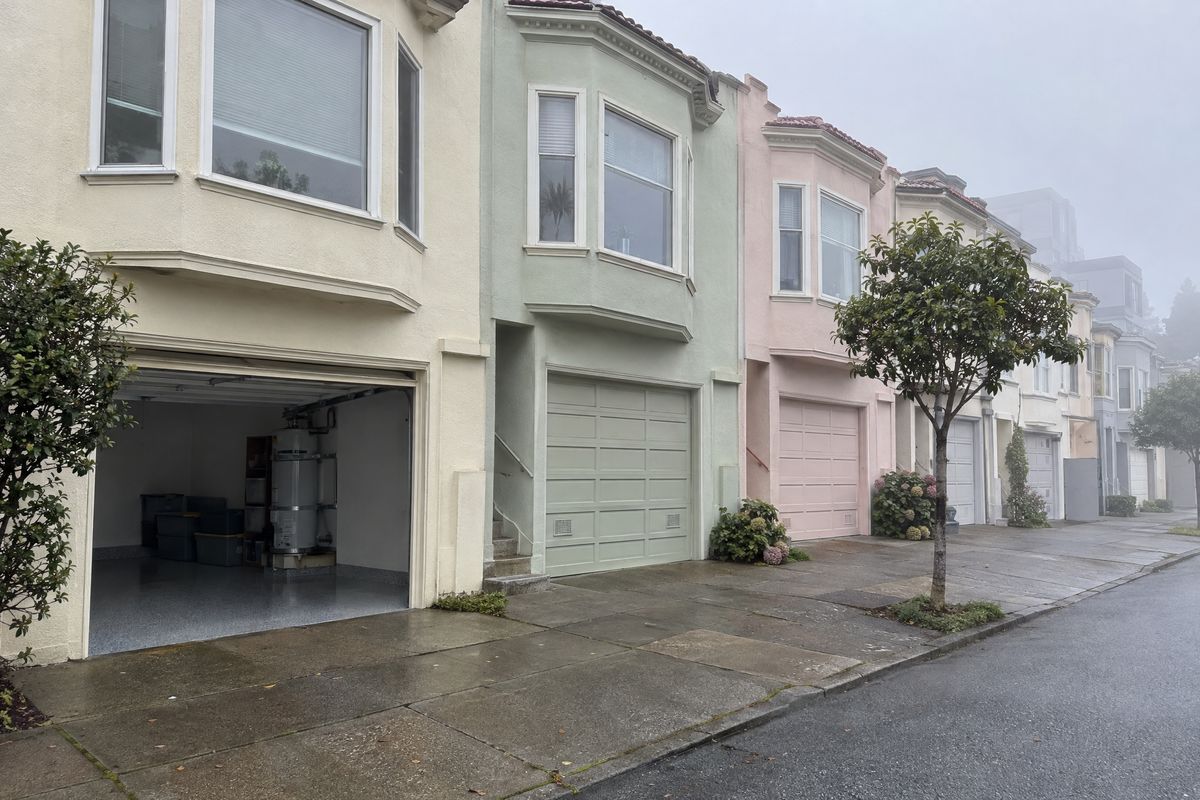
In the Sunset District, the floor to coat is often the garage slab at a house's ground story, so an epoxy job here turns on that slab's moisture, the cool ocean-side air it cures in and the Bay Area Air District's cap on volatile organic compounds (VOC), the vapors a coating gives off as it cures. SF Planning's 1925-1950 context statement pictures the district's typical home as "a stucco-clad, single-family house, with integrated garage at the ground story and living spaces above," set "tightly packed on 25-foot-wide lots." With living space directly over the slab, each product's VOC figure is worth reading before the work starts.
Requests sent through this page's form land with a local installer who works independently of the site and holds a California contractor license. Everything after that, from the written quote to the contract to the finished Sunset floor, is between you and that installer; check the license number on the Contractors State License Board (CSLB) site before signing. No survey publishes prices for the Sunset or for San Francisco as a whole, and the national ranges, dated and credited to their surveys, sit on the epoxy cost page. Below come the district's buildings, ground and rules, each service on a Sunset slab, and the hiring terms.
with requests passed to installers who hold California contractor licenses.
Free quote
Sunset District houses, garages, dune sand and survey rules
The Sunset District was built late, and then quickly. In the mid-1850s it lay in what SF Planning's context statement calls the Outside Lands, "a vast area of sand dunes that was outside of the City's boundaries," and early maps labeled it the "Great Sand Waste." Dunes and distance helped hold off large-scale building until the mid-1920s. Then the tracts went up together: the district "contains over 25,000 buildings," "more than 15% of the City's building stock," and 96% of those in the survey area are single-family houses of the 1925-1950 period. "Construction peaked in 1940, with 499 houses constructed in that year alone." The statement adds that, "With few exceptions," those tract houses took the garage into the house itself, with the rooms set above it.
SF Planning's counts show how uniform that stock still is. The SunsetForward profile of Supervisor District 4 says "96% of housing units in D4 were built pre-1960" and "Over 70% of residential buildings in D4 are single-family homes," and its tenure chart reads 61% owner-occupied. The 2025 Housing Inventory (April 2026) counts 27,277 units in Sunset/Parkside, 19,522 of them single-family, with a net gain of 46 during 2025. The Inner Sunset is more mixed: SF Planning's 2012-2016 profile of that analysis neighborhood gives a median year built of 1952, 43% single-family housing and 28% in buildings of 2-4 units. The Historic Preservation Commission adopted a separate Inner Sunset context statement, for the area from Arguello Boulevard west to 19th Avenue, on March 20, 2024.
The district began as sand. SF Planning's residence parks context statement (October 2016) says the present-day Richmond and Sunset Districts "were vast foggy sand dunes," the same soil the Richmond District page starts from. The National Weather Service's "Climate of San Francisco" memorandum describes summer mornings with "only partial clearing on the cooler ocean side," the side the Sunset fronts, with the Pacific as its western edge. U.S. Geological Survey Open-File Report 2006-1037 rates dune sand as moderate for liquefaction, the loss of strength in water-saturated ground during strong shaking, "because coastal dune environments typically have deeper ground-water levels." Whether a lot lies in a State zone is an address look-up in the California Geological Survey's EQ Zapp tool. Neither the fog nor the sand gives a number for one garage, so moisture is settled at the slab, by test.
The district's historic review question comes from SF Planning's Sunset District Historic Resource Survey. The Historic Preservation Commission adopted its context statement on April 3, 2013 and its findings on September 18, 2013. Of 2,874 properties in the survey area, 2,762 were evaluated; 84 buildings appear individually eligible, and three districts holding 389 buildings, the Sunset Picturesque Period Revival Tracts, the Sunset Mediterranean Revival Tracts and Rivera Heights, appear eligible for the California or National Registers but "have not been formally designated." The survey FAQ says the results "are not a Landmark designation of a building" and "do not prohibit property owners from making alterations to the exterior or the interior." It also notes that "certain alterations to buildings over 50 years old require environmental review," and every house of the 1925-1950 period is now past that age.
Two newer documents frame what comes next. The Family Zoning Plan, adopted by the Board of Supervisors on December 9, 2025 and in force from January 12, 2026, focuses on "the western and northern parts of San Francisco," yet SF Planning answers that "changes to existing buildings or demolition of existing buildings are not required when the zoning is updated." The Planning Commission endorsed the Sunset Forward Strategies Report on October 13, 2022. Commerce runs along five Neighborhood Commercial Districts that the SunsetForward profile names: Taraval Street, Judah Street, Inner Sunset, Noriega Street and Irving Street. On Noriega, 19% of the business mix is fast food and 15% medical services; on Irving, 10.6% is full-service restaurants.
See Sunset District, San Francisco on Google Maps — requests from San Francisco reach independent installers who hold a California contractor license.
Coatings for Sunset District Garage Slabs and Converted Rooms
Each home service below lands on the same floor: a slab at the ground story, under living space, on former dune sand, in a district built mostly before 1960. Stonhard, a resin floor maker, cautions that "With concrete slabs that are over 25 years old, there is a risk that a moisture barrier was not installed." So the moisture test comes first for every one of these systems, and the cool air sets the schedule after it.
Garage floor epoxy over a Sunset ground-story garage
Garage floor epoxy in a Sunset house goes down under the rooms a household lives in, and the calcium chloride test is one way to read the slab first. ASTM F1869 reports a vapor emission rate, the pounds of moisture leaving a 1,000-square-foot area in a 24-hour period, and KTA-Tator, a coatings inspection firm, describes the sealed dome sitting on bare concrete "for 60-72 hours." Sherwin-Williams' Form G-1 (revised 02/26) allows "not more than 3 pounds of moisture per 1,000 square feet per 24 hours" under its resin floors and asks for "Three tests" in the first 1,000 square feet; HomeGuide's February 2026 survey sizes a one-car garage at 288 to 392 square feet, so a one-car slab falls inside that first 1,000 and takes three domes. ASTM's page adds that the rate "only reflects the condition of the concrete floor at the time of the test."
The air sets the rest. The ArmorSeal 1000 HS data sheet from Sherwin-Williams, in its August 10, 2021 revision, gives a 50 degrees F application minimum and an 85% humidity maximum, and at that minimum it waits 48 hours for foot traffic and 10 days for a full cure. The San Francisco Downtown station's 1991-2020 NOAA normals put the daily low under 50 degrees F in every month from December to April, with January lowest at 46.6 degrees F; that is outdoor air downtown, not a Sunset reading. A garage slab has its own temperature, and that is the figure to ask the installer for. Month-by-month normals sit on the San Francisco floor data page.
Polyaspartic floor coating for a Sunset garage in daily use
Polyaspartic floor coating, the quick-curing aliphatic polyurea family, fits a Sunset garage whose car must be back inside soon, and by SF Planning's 2012-2016 profile most Inner Sunset households have one: it counts 15,830 vehicles available there and 17% of households with none. Laticrete's low-VOC Spartacote Flex Pure (data sheet DS-86.6-0126) prints "Walk-on in 3-4 hours" and a "24-hour return to service," figures Laticrete states for 70 degrees F and 50% RH, and warns that "Increases in temperature and/or humidity will shorten working time, dry time and recoat windows." Its VOC line reads "<100 g/L (as intended for use)." The Air District allows a floor coating 100 grams of VOC per liter, and Laticrete prints "<450 g/L" for its solvent-based Flex SB, so the written quote should name the product and its figure.
Metallic epoxy for a converted Sunset ground floor
Metallic epoxy, a resin coat in which pigment disperses into a pattern as the coat cures, belongs where a Sunset garage becomes a room, and SF Planning's rules for that change come before the floor. Its accessory dwelling unit (ADU) page says "Many ADUs are converted from existing storage or garage space." In a district where "Over 70% of residential buildings in D4 are single-family homes," two of the page's routes fit a house: a Junior ADU, which can "convert up to 500 square feet of space in a single-family structure," or a room that adds no unit, with an affidavit to "make sure this space won't be used as another residential unit." Where the conversion needs a building permit, CSLB's bulletin #24-07 says a contractor license is required at any price.
The slab shows through this finish. Sherwin-Williams' Form G-1 sets its Resuflor Topcoat Metallic II at CSP 3, a light-shotblast grade on ICRI's ten-step scale of concrete surface profile (CSP), which runs from acid-etched CSP 1 to the breaker-and-blast CSP 10. Sherwin-Williams also says of that smooth system that "substrate imperfections must be corrected or they can reflect through the system." The metallic coat goes over "A pigmented basecoat," whose color "will influence the overall appearance of the floor." Laticrete's pigment data sheet DS-85.7-0819 says "Mock-ups and field test areas are required," so ask where the sample will be made before the floor is poured.
Stained concrete for a Sunset garage floor
Stained concrete colors the slab itself, and in a Sunset garage its sealer is the layer the car meets. Acid stain works by chemistry: the ASCC Concrete Polishing Council describes it as a "Reactive solution of one or more metal salts stabilized by acid that produces coloration in a concrete substrate." HomeGuide's February 2026 staining survey prices a stained garage floor at $5 to $25 per square foot nationally, or $1,400 to $9,800 for one car, and says "Stained concrete should be sealed every 1 to 3 years."
Euclid Chemical's bulletin CP-22 explains why the sealer matters under tires: hot tires release plasticizers, and "Most discoloration from plasticizer migration occurs on acrylic or styrene/acrylic cure & seals," while epoxy and urethane coatings "are much more crosslinked." For a Sunset garage that means a stain at up to 250 grams of VOC per liter under the Air District's Table 2, sealed with a concrete/masonry sealer held to 100.
Commercial Floors on the Sunset's Neighborhood Shopping Streets
SF Planning's SunsetForward profile names five Neighborhood Commercial Districts in the Sunset and gives part of the business mix on two of them: fast food is 19% on Noriega and full-service restaurants 10.6% on Irving, with medical services at 15% on Noriega. The four services below follow that mix, from shop and clinic floors to kitchens under the Retail Food Code, small polished floors, and worn slabs that need resurfacing before anything else.
Commercial epoxy flooring for Sunset shops and clinics
Commercial epoxy flooring for a Sunset shop or clinic is sized, in mils or thousandths of an inch, by the traffic and cleaning it must take. ICRI 310.2R groups resin layers into "Thin films, 4 to 10 mils" and "High-build coatings, 10 to 40 mils." Under 29 CFR 1910.22(a)(2), federal OSHA requires "The floor of each workroom" to be kept clean and, "to the extent feasible, in a dry condition." For floors that get wet, TCNA's summary of ANSI A326.3 lists ">= 0.42 wet DCOF or Manufacturer-Declared" for its "Interior, Wet" category, DCOF being the dynamic coefficient of friction, though TCNA warns that it "does not predict the likelihood a person will or will not slip." On VOC, a Sunset storefront floor coating is held to the Air District's 100 grams per liter, and one recommended for several categories meets "the most restrictive limit," subject to the rule's exceptions.
Restaurant kitchen floors on Irving Street and Noriega Street
Commercial kitchen flooring is a live question on Irving Street and Noriega Street, given those restaurant shares, and the California Retail Food Code sets the standard. Health and Safety Code section 114268(a) wants floors where food is prepared or stored to be "smooth and of durable construction and nonabsorbent material that is easily cleanable." Section 114268(b) adds a cove with a "3/8 inch minimum radius" that runs "up the wall at least 4 inches." Section 114269(a) requires floor drains in water-flushed floors "Upon new construction or extensive remodeling," with surfaces "sloped 1:50 to the floor drains."
Urethane cement, a polyurethane resin filled with cement, is the system its makers describe for hot washdowns. Dur-A-Flex's sheet for Poly-Crete HF, dated 6/18/2013, puts a typical layer at 1/4 to 3/8 inch and says the product is most suited to application at temperatures between 50 and 85 degrees F. Its service range reaches 220 degrees F at the hot end and -100 degrees F at the cold. Light traffic waits 6 to 8 hours and full service 3 to 5 days, so a kitchen plans on closing for days, not hours.
Polished concrete for small Sunset shop floors
Polished concrete, which is the existing slab cut down and refined to a set gloss, is priced by area, and a converted Sunset garage sits in the survey's small-floor band. HomeGuide's February 2026 survey shows the effect of size: a floor under 1,000 square feet often runs between $8 and $15-plus a square foot, and one over 5,000 may drop to $3 to $6, both national.
The work is a sequence of cuts. The ASCC Concrete Polishing Council's glossary places grinding at "100 grit or lower," honing "within the 100-400 grit range" and polishing at "800 grit or higher." The silica rule Cal/OSHA keeps at Title 8 section 1532.3 offers walk-behind floor grinders two control options: an integrated water feed at the cutting surface, or the maker's recommended dust collection with a filter rated "99% or greater efficiency," and indoors a HEPA vacuum for loose dust "in between passes." Ask which option the crew will use if the shop stays open.
Concrete resurfacing for cracked Sunset garage slabs
Concrete resurfacing here refers to floor slabs only: a fresh cement-based topping over a worn surface, which depends on the cracks beneath it having stopped moving. NRMCA's CIP 4 says early random cracks "rarely affect the structural integrity or the service life of concrete," while ICRI's terminology defines an active crack as "any crack that is still moving." ACI's overlay FAQ says "Any active cracks need to be stabilized to avoid being reflected through the topping." Wolverine Coatings calls a slab that is "crumbling, rocking back and forth, heaving, or sinking" "an unlikely candidate for coating without repair." In HomeGuide's February 2026 survey, a basic garage resurfacing design runs $3 to $5 a square foot and a complex one $4 to $7, both national figures.
Hiring an Installer for a Sunset District Floor
California sets the license line at $1,000 in labor and materials. CSLB's bulletin #24-07 of December 31, 2024 explains that Assembly Bill 2622 raised the minor work exemption to that figure from January 1, 2025, and says a license is still required below it "if the minor work is subject to a permit requirement of any kind" or if the person hires workers. HomeGuide's national figures for a one-car epoxy garage start at $1,200, above the line. CSLB's definitions touch this work in more than one class: the D-12 Synthetic Products subcategory of C-61 names "resin and epoxy application," and D-6 Concrete-Related Services includes "floor hardening treatment, coloring concrete," so check the class printed on the license. The hiring guide sets the steps in order.
- Look the license number up on CSLB's site, read the classification printed with it, and confirm the name matches the one on your quote.
- Expect a contract headed "Home Improvement" that lists the contractor's license number and a "Description of the Project and Description of the Significant Materials to be Used."
- Section 7159.5 limits the down payment to the smaller of 10 percent of the contract amount and $1,000; after that, no payment may exceed the value of work performed or material delivered.
- The contract must carry a "Three-Day Right to Cancel" notice, or "Five-Day" for a senior citizen, unless section 7159 excepts it, as with a contract negotiated at the contractor's place of business; the clock starts when you receive a signed and dated copy.
- The Sunset survey is not a landmark designation, but certain alterations to buildings over 50 years old need environmental review; ask SF Planning about that and the Department of Building Inspection about permits.
- Have the quote list each product's VOC in grams per liter, so it can be read against the Air District's 100 for floor coatings and concrete/masonry sealers and 250 for stains.
- For the visit, have the garage's size, any damp patches, cracks, oil or old paint, and the date the car must be back in.
Sunset District FAQs
What does it cost to coat a Sunset District garage floor?
No survey publishes a Sunset District price, so every figure is national. HomeGuide's February 3, 2026 epoxy survey sizes a one-car garage at 288 to 392 square feet and prices it at $1,200 to $3,900 installed; for two cars it gives $1,600 to $5,800 over 400 to 576 square feet. Its polyaspartic page of November 18, 2024 gives $1,400 to $4,700 for one car and puts moisture and hardness testing at $50 to $300. The installer's written quote, made after measuring and testing the slab, is the only price for your floor; the cost page gives every survey's range and date.
Is a permit required to coat a garage floor in the Sunset?
San Francisco's Department of Building Inspection (DBI) answers that under the City's own Building Code, not the State's list. The California Residential Code's section R105.2 exempts "Painting, papering, tiling, carpeting, cabinets, counter tops and similar finish work," but the City's 2025 code swaps in its own Chapters 1 and 1A for that part of the State text. The Sunset survey's results, by SF Planning's FAQ, are not a landmark designation and do not prohibit alterations. The hiring guide covers permits and licenses together.
Can I turn my Sunset garage into a room with a coated floor?
SF Planning's accessory dwelling unit page describes routes for both a new unit and plain living space, and in either job the floor comes last. The page says "Yes, you may create living space in your home without creating an ADU," with an affidavit, and a Junior ADU can convert up to 500 square feet of a single-family structure. A conversion that needs a permit also needs a contractor license whatever its price, per CSLB's bulletin #24-07, and SF Planning notes environmental review for certain alterations to buildings more than 50 years old, which describes nearly every Sunset tract house.
Does fog in the Sunset affect an epoxy floor?
Fog matters through two readings taken on the day: air humidity, and the slab's temperature against the dew point, below which a cold slab collects water condensed from the air. Sherwin-Williams' amine blush article says "Avoid condensation by staying at least 5 degrees F above the dew point prior to and throughout the application and cure," and its Resuflor Deco Flake SB instructions add that work on concrete "should occur while temperature is falling." Its ArmorSeal 1000 HS sheet caps relative humidity at 85%. Station normals describe outdoor air downtown; the readings to rely on are taken in the garage itself.
What is the downside of epoxy flooring?
On a Sunset garage slab the main downsides are sensitivity to moisture, slow cure in cool air and color change in light. Sherwin-Williams says "Standard epoxy systems are not moisture-tolerant," which is why an older ground-story slab is tested first. The ArmorSeal figures above show the cool-air delay, and the same sheet warns that "Epoxy coatings may darken or yellow following application and curing." For the last point, Citadel describes polyaspartic applied as a top coat over epoxy or polyurea bases "to deliver rapid curing, UV stability, and enhanced chemical resistance."
Request a Floor Quote for Sunset District
Free quote