San Francisco Epoxy Floors Co.
(415) 801-3047Floor coatings and the rules for Daly City, in San Mateo County.
Epoxy Floors and Garage Coatings in Daly City, CA
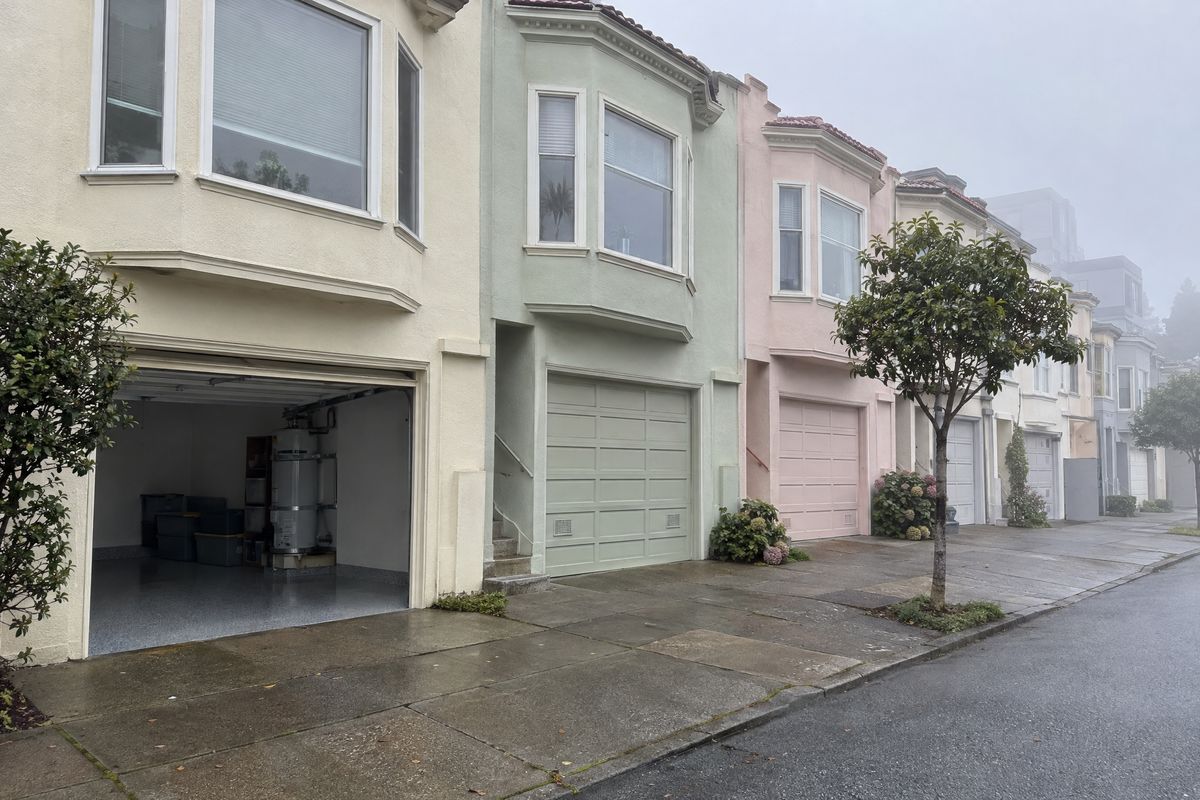
Most of Daly City's homes are decades old, so an epoxy floor here usually goes on an old slab, and three things decide the job: the moisture rising through that slab, the cool air the coating cures in, and the rules of Daly City's own building division. By the counts in the Census Bureau's 2020-2024 American Community Survey, about six in ten of the city's 35,922 homes went up between 1950 and 1979, and the survey puts the median year built at 1965. In its Sunset District context statement, San Francisco Planning writes of the one-story house set over its garage, "There are no known examples outside of San Francisco (and later, Daly City)," and in a house of that form the garage sits at the ground story, under the living space.
No price survey publishes a Daly City figure, so the national ranges on the cost page, each with its survey and date, are the benchmarks. This page hands your request to an independent local installer, and that installer holds a California contractor license; look the number up with the Contractors State License Board before anything is signed. You and the installer are the two parties to the quote, the contract and the work. Below, each home and business floor type is set against Daly City's housing, air and rules, and a hiring checklist closes the page.
with requests passed to installers who hold California contractor licenses.
Free quote
Daly City's Houses, Garage Slabs, Air and Building Rules
Daly City governs itself as one of San Mateo County's cities, with its own building inspection, so San Francisco's city codes stop at the county line. LAFCo, the county's Local Agency Formation Commission, counts it among "the 20 cities" under its jurisdiction, dates its incorporation to March 22, 1911, puts its area at 7.66 square miles, and names building inspection, planning and fire among the services the City provides. The 2020 Census found 104,901 residents and the July 1, 2025 estimate is 101,261; LAFCo's 2015 review of the north county called Daly City the county's largest city by population. Census QuickFacts gives an owner-occupied share of 60.2% and a median owner-occupied home value of $1,115,000 for 2020-2024.
Most homes are single-family houses. The 2020-2024 American Community Survey counts 17,711 detached and 5,070 attached single-family homes among 35,922, more than six in ten by that count, and 3,210 in buildings of 50 or more units. By decade, 8,807 homes date from the 1950s, the largest group, 6,056 from the 1960s and 7,072 from the 1970s, while 3,197 predate 1940 and, by the same counts, only about one in sixteen dates from 2000 or later. Age matters under a coating: Stonhard, a resin floor maker, warns that "With concrete slabs that are over 25 years old, there is a risk that a moisture barrier was not installed," and the median Daly City home, built in 1965, is more than twice that age. The Sunset District page covers the San Francisco side of the same house form.
Two NOAA stations supply the climate figures used here, through their 1991-2020 normals: the Downtown station in San Francisco and the one at San Francisco International Airport. Neither sits in Daly City, and both measure outdoor air, not a garage or a slab. Downtown's normal January low is 46.6 degrees F, the airport's 44.5 degrees F, and Downtown's annual mean 57.7 degrees F. Sika's Sikafloor-264 epoxy sheet wants ambient air of 50 degrees F or more and a substrate "at least 5 degrees F (3 degrees C) above measured Dew Point," the temperature at which water in the air condenses on a cold surface. It also warns that unvented heaters can cause blushing, and Sherwin-Williams describes amine blush as "a sticky, oily, or waxy appearance on the surface," so a winter coat depends on the garage's own readings. The monthly station normals are on the data page.
Ground conditions are checked address by address. The California Geological Survey (CGS) maps State seismic hazard zones for liquefaction, in which loose, water-saturated sediments "lose strength and fail during strong ground shaking," and for earthquake-induced landslides, which "tend to occur in weak soil and rock on sloping terrain"; its EQ Zapp lookup shows whether a given lot falls in one. Inside a zone, CGS says, "cities and counties must require a site-specific investigation" before a development permit is issued, and since June 1, 1998 the seller or the seller's agent has had to tell a buyer when a property lies in one. A slab that has settled on such ground is a question for an engineer before it is a coating question; HomeGuide's February 3, 2026 resurfacing survey prices a structural engineer at $100 to $200 per hour, nationally.
Permits for a Daly City floor come from Daly City. The California Building Standards Commission lists the 2025 California Building Standards Code (Title 24) as effective from January 1, 2026 to December 31, 2028, and its list of 2025 local ordinances shows a Daly City filing, "1484-Partial", with no date or code list given. In the State's 2025 California Residential Code, section R105.2 places "Painting, papering, tiling, carpeting, cabinets, counter tops and similar finish work" under the line "Permits shall not be required for the following," but whether Daly City keeps that list, and whether your coating job fits it, is for Daly City's building division to say. San Francisco's Building Code and its ADU program do not reach Daly City.
See Daly City, CA on Google Maps — requests from San Francisco reach independent installers who hold a California contractor license.
Floor Coatings for Daly City Garages and Homes
The four home systems below all go on concrete, which in a Daly City house means a garage slab or a ground-floor room built over one, and each starts with whichever moisture test its own data sheet calls for. ASTM F1869, the calcium chloride test, gives a rate "measured in pounds of moisture over a 1000 ft2 area during a 24-h period"; ASTM F2170 uses humidity probes left in holes drilled into the slab; and ASTM D4263, the plastic sheet method, only indicates whether capillary moisture is there. Past that first step, the systems part ways on film, speed and how much of the old slab shows.
Garage Floor Epoxy on Daly City's Mid-Century Slabs
Garage floor epoxy on a Daly City slab is a two-part coating, resin and hardener mixed on site, and the slab's age drives most of the preparation. Sherwin-Williams says "Older slabs may experience vapor transmission or delamination if not properly sealed or if coatings were applied without moisture testing," and its prep guide, Form G-1 (revised 02/26), passes a slab at "not more than 3 pounds of moisture per 1,000 square feet per 24 hours" by ASTM F1869, or at a probe reading of 80% or lower by ASTM F2170. Then the slab is ground, not acid-etched, to a concrete surface profile, CSP for short, a graded texture that gives the first coat something to grip; by Sherwin-Williams' account, acid etching tends to give only CSP-1 to CSP-2, a profile "suitable only for very thin systems."
The garage air sets the cure. Sikafloor-264's sheet allows foot traffic after roughly 24 hours at 50 degrees F and counts about 10 days to full cure there, while at 68 degrees F those shrink to about 12 hours and 7 days; whichever column the garage thermometer shows on the day is the one that applies. For price, HomeGuide's garage floor coating survey (December 24, 2024) gives one car on 288 square feet $1,200 to $3,500 and a 20 by 20 two-car floor $1,600 to $4,800, national figures with no Daly City row.
Polyaspartic Floor Coating for a Daly City Garage in Daily Use
Polyaspartic floor coating is the fast-curing choice when the car has to come back the next day, and the normal January lows of outdoor air at both San Francisco stations fall inside the polyaspartic range in Citadel's table. Laticrete defines the term: "the term 'polyaspartic' refers to an 'aliphatic polyurea'". In Citadel's comparison table, the polyaspartic grout coat goes down at "0 degrees F - 90 degrees F+" where epoxy needs "> 50 degrees F", and full return to service is 24 hours for the polyaspartic against 36-48 hours for epoxy, both "Ambient Dependent". On an old slab, Concrete Decor magazine warns that "Flaws or obvious repairs in the underlying floors will be reflected." HomeGuide's November 18, 2024 survey sets polyaspartic at $5 to $12 a square foot, against epoxy's $4 to $10, and says the total "ranges from $2,000 to $6,900 for a standard 2-car garage."
Metallic Epoxy for a Daly City Garage Turned Into a Room
Metallic epoxy suits a garage that has become a studio, office or family room, and in Daly City the conversion around it is the part with rules: Daly City's building division, applying the State code as the City amends it, is the office that says what that work needs, and San Francisco Planning's ADU program is written for San Francisco. On the floor itself, Laticrete's metallic pigment sheet, DS-85.7-0819, describes "aluminum platelets coated with metal oxides" and says "Mock-ups and field test areas are required," while Sherwin-Williams calls its metallic system "a smooth system" in which "substrate imperfections must be corrected or they can reflect through the system." On an old slab, patches, saw cuts and oil stains are those imperfections, so expect grinding and filling before the colored base coat goes down.
Stained Concrete on Daly City Patios and Ground Floors
Stained concrete fits a sound Daly City slab when you want its history to stay visible, because a stain, in the Bay Area Air District's definition, is made "to change the color of a surface but not conceal the grain pattern or texture." On a slab poured in the 1950s or 1960s, the patches, cracks and worn paths remain in view after staining. In the Air District's Regulation 8, Rule 3, whose text is dated July 1, 2009, a stain's ceiling is 250 grams per liter and a concrete or masonry sealer's is 100, counting volatile organic compounds (VOC), the carbon-based vapors a coating releases as it dries, in a Table 2 effective from January 1, 2011. For an existing floor, HomeGuide's staining survey (February 3, 2026) runs from $3 to $15 a square foot nationally, and it says stained concrete "should be sealed every 1 to 3 years."
Commercial Floors in Daly City: Shops, Kitchens, Shared Garages
A business floor in Daly City, such as a shop, a restaurant kitchen or the parking level of an apartment building, follows the same State license rules as a home job, while the contract rules can differ: CSLB describes section 7159's home improvement contract requirements as covering work on "residential property," and CSLB is the body to ask how that applies to a shared garage in an apartment building. Ask Daly City's building division about any drain, wiring or layout change, and ask the installer which Air District category each product is sold under.
Commercial Epoxy Flooring for Daly City Shops and Parking Levels
Commercial epoxy flooring is sized to the traffic, and Sherwin-Williams puts "the great majority" of contractor resin floors at "0.020 to 0.250 inches (20 - 250 mils)," each mil one thousandth of an inch, with thickness, chemical resistance, cost and life expectancy climbing "from coatings, to slurries, to broadcast systems, to trowel applied floors, to epoxy terrazzo." A shared parking level takes tires, oil and wet shoes, so grip matters: Sherwin-Williams says of its Resuflor Deco Flake II that "Textured finishes aid in a safer floor, even when wet," and lists its wet DCOF, the dynamic coefficient of friction on a wet surface, as greater than 0.42 by ANSI A326.3. TCNA, the Tile Council of North America, adds that the number "does not predict the likelihood a person will or will not slip-on a given surface."
Restaurant Kitchen Floors in Daly City Under the State Food Code
Commercial kitchen flooring in Daly City answers to the California Retail Food Code, which is State law; San Francisco's public health department wrote its construction guide for San Francisco kitchens. Section 114268 of the Health and Safety Code requires that floors in food preparation and storage areas be "smooth and of durable construction and nonabsorbent material that is easily cleanable," coved at the wall "with a 3/8 inch minimum radius coving" that extends "up the wall at least 4 inches," and section 114269 calls for floor drains where floors are water-flushed for cleaning, with the floor "sloped 1:50 to the floor drains," upon new construction or extensive remodeling. New drains and floor sinks are plumbing, so take them to Daly City's building division.
Urethane cement is a urethane resin filled with cement-based powders, troweled or poured many times thicker than a coating, and its makers pitch it at heat and washdowns. The Poly-Crete HF sheet from Dur-A-Flex, dated 6/18/2013, says "It is typically applied 1/4 -3/8 inch thick depending on design requirements," rates it for service from -100 up to 220 degrees F, live steam included, and states "Repeated exposure to hot oil or steam does not cause pitting, cracking or crazing." The sheet's timings are "Light Traffic 6-8 hours" and "Full Service 3 - 5 days," and the sheet favors application between 50 and 85 degrees F.
Polished Concrete for Daly City Shop Floors and Garage Slabs
Polished concrete leaves no coating on top: diamond tooling grinds and hones the slab itself until it reaches a specified gloss, so what the slab is made of is what you see. The ASCC Concrete Polishing Council's glossary divides the work into grinding with "any bonded abrasive that is 100 grit or lower," honing with "diamond tooling within the 100-400 grit range," and polishing at "800 grit or higher." Size moves the price per foot: below 1,000 square feet, HomeGuide's February 8, 2026 survey says jobs often carry $8 to $15 or more, nationally, and every garage size in HomeGuide's epoxy tables falls below that mark. Indoor grinding comes under the silica rule Cal/OSHA keeps in Title 8, section 1532.3, whose Table 1 gives walk-behind floor grinders water feed or a dust collector, plus a HEPA-filtered vacuum, one with a high-efficiency particulate air filter, between passes.
Concrete Resurfacing for Worn and Cracked Daly City Slabs
Concrete resurfacing gives a worn but stable slab a new cement surface; it does not hold a moving one still. ARDEX's K 301 sheet says "Thinly applied, non-structural overlays are not capable of restraining movement in the structural slab, which could lead to reflective cracking," and the International Concrete Repair Institute separates a dormant crack, "not likely to become active in the future," from an active one that is "still moving." Among the causes of cracking NRMCA's CIP 4 lists are "Improper subgrade preparation" and "Inadequate or no curing." On HomeGuide's February 3, 2026 survey, a basic resurfacing design on a garage floor runs $3 to $5 per square foot nationally, and in the survey's words, cracks wider than a quarter inch "typically indicate foundation problems."
Hiring a Floor Installer for a Daly City Job
California's contractor rules are State law, so they read the same in Daly City as across the county line, while the permit, the tax rate and the inspections are Daly City's. On CSLB's applicant page, a license is needed when "the total cost (labor and materials) of one or more contracts on the project is $1,000 or more," or below that "if the project requires a building permit or uses any additional workers," and section 7048(b) shuts the door on dividing a job into small contracts "for the purpose of evasion of this chapter or otherwise." The hiring guide sets out the license classes, the contract terms and the right to cancel in the statutes' words.
- Look up the installer's license number with CSLB's License Check and ask which classification it is in; section 7117.6 makes contracting outside that classification a cause for discipline.
- For a home job over $500, section 7159 calls for a written contract whose list of contents starts with "The name, business address, and license number of the contractor"; its materials description is the place to name each coating and its thickness.
- Section 7159.5 sets the down payment ceiling at one tenth of the contract amount, up to $1,000 at most, and bars any later payment that "exceeds the value of the work performed or material delivered."
- The contract must include the statute's notice, "You, the buyer, have the right to cancel this contract within three business days," with five days for a senior citizen, unless it was "Negotiated at the contractor's place of business."
- Ask Daly City's building division whether the coating, and any conversion, drain or wiring that comes with it, needs a permit; the City has filed amendments to the 2025 State code.
- Table 2 of the Air District's Regulation 8, Rule 3, as dated July 1, 2009, lists "Floor Coatings 100," a count of grams of VOC in each liter; the quote should give each product's figure.
- Have ready for the visit: the floor's size, the house's age if you know it, damp patches, cracks or old coating, and the date the car or business needs the floor back.
Daly City FAQs
Is it expensive to epoxy a garage floor in Daly City?
By HomeGuide's national survey, an epoxy garage floor runs from $1,200 for one car to $5,800 for two, and no survey publishes a Daly City price. HomeGuide's epoxy flooring page (February 3, 2026) gives $1,200 to $3,900 installed for one car, a floor of 288 to 392 square feet, and says "An epoxy floor costs $1,600 to $5,800 for a 2-car garage," with labor alone at $3 to $5 a square foot. Repairs come on top: the same page prices floor resurfacing at $3 to $7 a square foot. Every survey and its date sit in the published cost table.
Does a garage floor coating need a permit in Daly City?
Daly City's building division decides, since the City applies the State code with amendments of its own. The State's 2025 California Residential Code, in section R105.2, lists "Painting, papering, tiling, carpeting, cabinets, counter tops and similar finish work" under "Permits shall not be required for the following," and the Building Standards Commission shows a Daly City ordinance amending the 2025 code without listing what it changes. New wiring, a drain or a garage conversion raises its own permit question, and once any permit is involved, CSLB requires a contractor's license whatever the price; the hiring guide's permit notes set out the State text.
Can I epoxy my garage floor myself?
Yes, epoxy kits are sold for owners to apply, but the slab test and the cool air apply to you as much as to an installer. HomeGuide's February 2026 survey prices premade epoxy kits at $200 to $700, nationally, and its polyaspartic survey marks epoxy as DIY-friendly and polyaspartic as not; Concrete Decor magazine says of polyaspartics, "This is not a do-it-yourself product." Under the Air District's September 1, 2011 advisory, coatings made after the rule's effective dates need to meet its limits "to be sold in the District," and the rule's July 1, 2009 version sets 100 grams per liter for floor coatings; the Sikafloor-264 sheet sets a 50 degrees F minimum for the air.
Does San Francisco's building code apply in Daly City?
No: Daly City is its own city within San Mateo County, with its own building inspection, and San Francisco's code is, in its own words, the "2025 San Francisco Building Code." San Francisco Planning's ADU program and the San Francisco health department's kitchen guide are likewise written for San Francisco. In Daly City the 2025 State code applies as the City amends it, so the Daly City building division answers coating, conversion and kitchen-drain questions. State law, including CSLB licensing, the home improvement contract rules and the Retail Food Code, applies in both cities.
Which sales tax rate covers floor work in Daly City?
CDTFA's rate table, in force from October 1, 2026, sets the City of Daly City's combined rate at 9.875%; San Mateo County outside the cities with their own add-on taxes is at 9.375%. How it applies depends on the contract: CDTFA's Publication 9 says "Construction contractors are generally the consumers of materials" and "The contractor's jobsite is considered the place of business for purposes of determining the applicable tax." Your written quote should spell out the tax treatment; for a ruling, CDTFA or a tax professional you consult has the last word.
Request a Floor Quote for Daly City
Free quote