San Francisco Epoxy Floors Co.
(415) 801-3047Floor coatings and the rules for South San Francisco, in San Mateo County.
Epoxy Floors for Labs, Plants and Homes in South San Francisco
Epoxy floors in South San Francisco serve two kinds of building: the labs and warehouses of a city that calls itself "the birthplace of biotechnology," and the garages of a housing stock that, by the Census counts, went up mostly before 1970. The City counts "Over 250 biotech companies and 12 million square feet of biotech space," while the 2020-2024 American Community Survey finds 23,515 homes with a median year built of 1965. What decides a floor here is the slab's moisture and movement near the bay, the chemicals and static a lab floor faces, the Bay Area Air District's limits on what a coating gives off, and the City's own Building Division.
No price survey publishes a South San Francisco figure, so the survey ranges on the cost page, each national and dated, are the benchmarks, and a lab or plant floor is priced from its own specification. Each request from this page is forwarded to an independent local installer, and the installer's California contractor license is yours to verify with CSLB before signing. The written quote, the contract and the floor itself all come from the installer, the party you contract with.
with requests passed to installers who hold California contractor licenses.
Free quote
South San Francisco's Industry, Houses, Bay Shore and Permit Rules
South San Francisco, incorporated in 1908, runs its own affairs on 9.5 square miles of San Mateo County, and the City places it "on the western shore of the San Francisco Bay," next to San Francisco International Airport. It grew as an industrial town: the City's history timeline records the Western Meat Company of 1893-1894 as "SSF's first major industry," Pacific Coast Steel and the Sanitary Bakery in 1909, and "South San Francisco the Industrial City" painted on the hill in 1923. Today the City calls itself the birthplace of biotechnology, dating the industry here to 1976, and counts more than 25,000 people working for over 250 biotech companies. The 2020 Census found 66,105 people; a Census estimate for July 1, 2025 gives 64,941.
Most of the housing went up from the 1940s on. The City says its population "has tripled since World War II" as subdivisions such as Buri Buri and Winston Manor opened; SF Planning's Sunset District context statement records a Sunset builder who "constructed 3,000 military units in South San Francisco, Benicia, Vallejo, and Oakland" in wartime; and the timeline notes a housing program under the Federal Housing Act in 1938 and the annexation of 530 acres of Westborough in 1962. The 2020-2024 American Community Survey counts 23,515 homes, 13,756 of them detached houses; only 1,620 predate 1940, 5,725 date from the 1950s alone, and by those counts more than half were built before 1970. Stonhard, a resin floor maker, warns that once a slab is past 25 years of age "there is a risk that a moisture barrier was not installed."
The land runs from hills down to the bay. The City describes a basin and valley "formed by the San Bruno Mountains," LAFCo's 2022 service review says "The eastern proportion of the City boundary is the San Francisco Bay," and the Colma Creek Flood Control Zone dates from 1964. The USGS, with the California Geological Survey, says much land beside the bay is underlain by deposits "particularly vulnerable to earthquake shaking and liquefaction," which happens, in CGS's words, when loose, water-saturated sediments "lose strength and fail during strong ground shaking"; the State's EQ Zapp lookup checks an address. For weather, the City reports "mild winters and dry cool summers" and says hills "shield the city from much of the fog." At NOAA's airport station next door, the 1991-2020 normal January low is 44.5 degrees F, a reading of outdoor air, which a slab can differ from.
Permits come from the City's Building Division, which lists the 2025 California codes, among them the California Building Code (2024 International Building Code) and the California Residential Code (2024 International Residential Code), with local amendments in Chapter 15 of the SSF Municipal Code. Its residential and commercial handouts, both revised 02/26, list "Painting, papering, tiling, carpeting, cabinets, counter tops and similar finish work" as exempt from permit. Its permit page adds that "electrical, plumbing, or mechanical work must still be permitted," asks owners to check with the Planning Division too, and says a structure to be "altered, repaired, moved, improved, removed, converted, or demolished requires a Building Permit Application." Whether a given floor job counts as finish work is the Division's call.
See South San Francisco, CA on Google Maps — requests from San Francisco reach independent installers who hold a California contractor license.
Floor Coatings for South San Francisco Homes and Garages
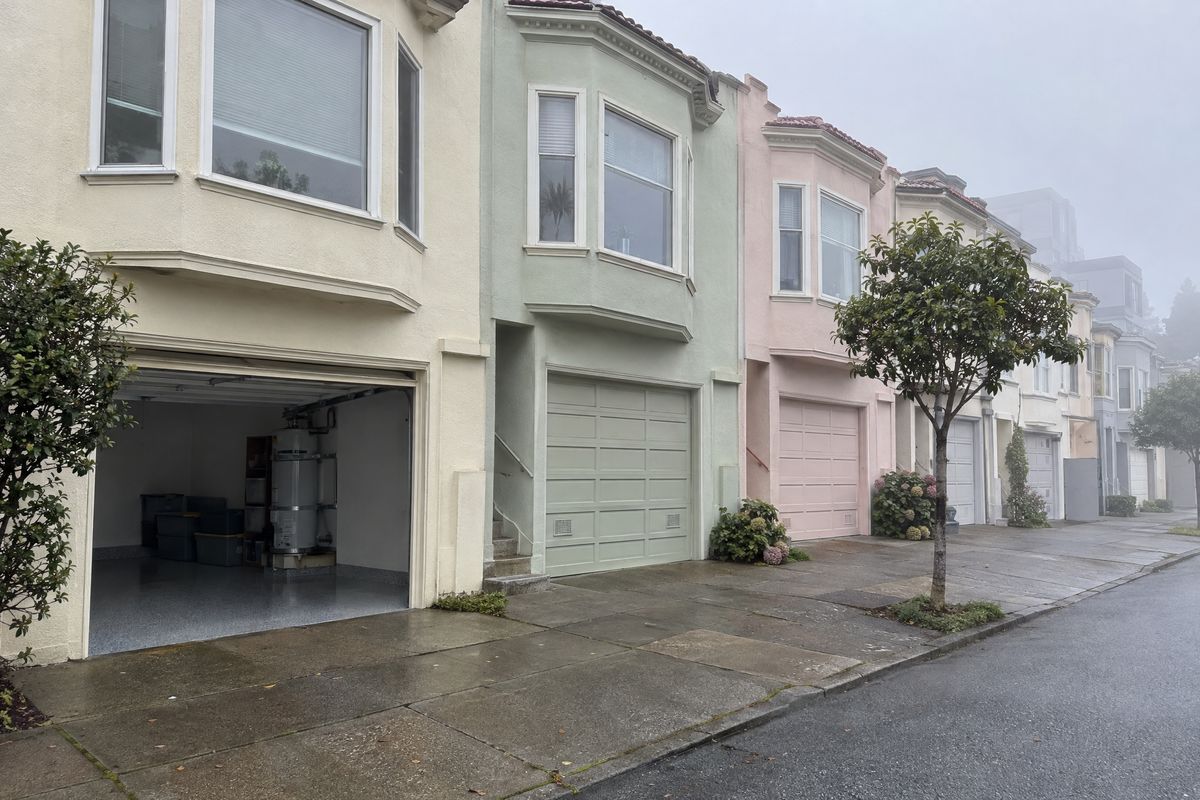
By the Census counts, more than half of South San Francisco's homes were built before 1970, so a home coating here often goes down on an old slab, and the four systems below differ in how much of that slab shows and how soon you have the room back. Each begins with the moisture test its data sheet names: a calcium chloride dome under ASTM F1869, in-place humidity probes under ASTM F2170, or, as a first look only, the plastic sheet method of ASTM D4263, which Sherwin-Williams says "will not quantify the amount of moisture movement."
Garage Floor Epoxy for South San Francisco's Postwar Houses
Garage floor epoxy begins as two liquids, resin and hardener, that are mixed in the garage and cure into a hard film, and on a postwar South San Francisco slab the first question is what the ground pushes up through it. Sherwin-Williams writes that moisture vapor transmission "occurs when water vapor moves upward through the concrete slab from the ground," and Simiron adds that "seasonal variations in ground moisture" can cause trouble "regardless of results measured prior to coating application," so one dry reading is a snapshot, as ASTM F1869 itself says of its result. Sika's Sikafloor-264 epoxy accepts in-place probe readings up to 85% by ASTM F2170, where the Form G-1 limit from Sherwin-Williams for non-permeable floors is 80% or lower.
Air temperature sets the pace of cure. At NOAA's San Francisco International Airport station, the annual normal daily maximum of the outdoor air is 66.9 degrees F. At 68 degrees F, the Sikafloor-264 sheet allows foot traffic after roughly 12 hours and counts 7 days to full cure, while at 50 degrees F those become roughly 24 hours and 10 days, so the garage's own air and slab readings pick the column. HomeGuide's December 24, 2024 garage floor coating survey prices a 24 by 24 two-car garage of 576 square feet at $2,300 to $6,900, nationally, and the station normals by month are on the data page.
Polyaspartic Floor Coating for a South San Francisco Garage
Polyaspartic floor coating buys speed at a higher price, and the humidity on the day of work is the limit to watch. Citadel describes its RG-80X as a "polyaspartic polyurea floor coating" to be applied "when air, material and floor temperatures are between 30-90 degrees F" and "the surface temperature is at least 5 degrees F (3 degrees C) above the dew point and RH less than 75%"; the dew point is the temperature at which the air's moisture beads on a surface. RG-80X is dry hard in 2-4 hours and takes vehicles after 24 hours. Laticrete notes that "Increases in temperature and/or humidity will shorten working time, dry time and recoat windows." HomeGuide's November 18, 2024 page reads "Polyaspartic floor coating costs $5 to $12 per square foot," nationally, and "ranges from $2,000 to $6,900 for a standard 2-car garage."
Metallic Epoxy in a Converted South San Francisco Garage
Metallic epoxy belongs in a garage that has become a room, and South San Francisco's Building Division frames the permit side in its own words: its permit page lists "converted" among the changes that require a Building Permit Application, its residential handout puts "similar finish work" on the exempt list, and wiring or plumbing for the new room "must still be permitted." The floor is the unforgiving part. Sherwin-Williams requires a pigmented base coat under its metallic layer "to serve as a canvas," and Laticrete's pigment sheet says "Mock-ups and field test areas are required," so ask for a mock-up on your own slab before the job is booked.
Stained Concrete for South San Francisco Patios and Floors
Stained concrete colors a slab rather than covering it, so it suits a sound patio or ground-floor room whose marks you are happy to keep. Table 2 of Regulation 8, Rule 3, in the Air District's July 1, 2009 text, lists "Stains 250" and "Concrete/Masonry Sealers 100" in grams of volatile organic compounds per liter, VOC for short, and the sealer is the coat you renew: HomeGuide's February 3, 2026 survey says stained concrete "should be sealed every 1 to 3 years," with sealing priced from $1 to $3 a square foot and staining an existing floor from $3 to $15, nationally. Outdoors, rain is part of the schedule: the airport station's normals give 19.64 inches of precipitation a year, with a January normal of 3.89 and a July normal of 0.00.
Commercial Floors for South San Francisco Labs, Plants and Kitchens
A business floor in South San Francisco answers to two local facts on top of the State rules: the Building Division's commercial handout lists "similar finish work" as exempt from permit under the 2025 California Building Code while electrical, plumbing and mechanical work still needs a permit, and the Bay Area Air District's rule on architectural coatings, Regulation 8, Rule 3, dated July 1, 2009, gives each coating category its own VOC limit. The scale is large. The City's April 2024 brochure counts 3.5 million square feet of biotech space under construction and expects life science floor space to double between 2019 and 2035, and sixty-one percent of the City's biotech companies work in biopharmaceutical research and development.
Commercial Epoxy Flooring for South San Francisco Biotech Labs
Commercial epoxy flooring for a lab is specified by the chemicals that land on it and the static it must carry away. For chemical rooms, makers turn to novolac epoxy, a highly cross-linked epoxy: Dur-A-Flex says its Dur-A-Glaze Novolac topcoat gives "protection against chemicals, acids, solvents, and high temperatures," with full chemical resistance after 7 days at 70 degrees F. Where static matters, an ESD floor, short for electrostatic discharge, "prevents the buildup and sudden discharge of static electricity," in Stonhard's words, in products from a 5-7 mil coat, mils being thousandths of an inch, to a quarter-inch mortar, and Dur-A-Flex warns that non-conductive waxes "will render the static dissipative properties ineffective."
The VOC category is part of the specification. Under Regulation 8, Rule 3, a coating may use the 250 grams per liter limit for industrial maintenance coatings only if it is formulated and labeled for one of the listed extreme conditions, such as "Immersion in water, wastewater, or chemical solutions" or "Acute or chronic exposure to corrosive, caustic, or acidic agents"; otherwise a floor coating's limit is 100, and where a maker recommends one product for several categories, section 8-3-302.2 applies "the most restrictive limit," with listed exceptions. Sherwin-Williams adds that "In general, the thicker the system, the better the chemical resistance."
Restaurant Kitchen and Food Plant Floors in South San Francisco
Commercial kitchen flooring in South San Francisco meets the State's Retail Food Code, and the City's permit page brings in the drains: floor drains and floor sinks are plumbing, and "electrical, plumbing, or mechanical work must still be permitted." Health and Safety Code section 114268 requires coving where floor meets wall "with a 3/8 inch minimum radius coving" running "up the wall at least 4 inches," and section 114269 says "Upon new construction or extensive remodeling, floor drains shall be installed in floors that are water-flushed for cleaning," with those floors "sloped 1:50 to the floor drains." San Francisco's own kitchen guide does not govern here; ask the health agency that reviews your plans what it needs to see.
Urethane cement, a urethane resin mixed with cement-based fillers and laid in fractions of an inch rather than in mils, is the family its makers offer for food areas. Sika's sheet for Sikafloor 22NA PurCem says "The system is typically installed at 3/16 to 1/4 inch (4.5 to 6 mm) thickness," lists service from 40 below zero up to 212 degrees F, and claims it "Meets the requirements of USDA for use in food plants"; Sherwin-Williams' USDA page explains that regulators do not approve individual floor products, so read such lines as the maker's claim. Sika also keeps ambient humidity between 30% and 85% while the slurry is laid and cures.
Polished Concrete for South San Francisco Warehouse Slabs
Polished concrete gets cheaper per square foot as the floor gets bigger, which favors the large slabs of warehouses and older industrial buildings. HomeGuide's February 8, 2026 survey says spaces over 5,000 square feet "may drop to $3 to $6 per square foot," against the $8 to $15 or more that projects under 1,000 often carry, nationally. The ASCC Concrete Polishing Council defines polishing as changing a floor surface "with or without aggregate exposure, to achieve a specified level of finished gloss," working from grinding at "100 grit or lower" to polishing at "800 grit or higher." Cal/OSHA's Title 8 section 1532.3 has walk-behind floor grinders run with water or with a dust collector whose filter has "99% or greater efficiency," and indoors a HEPA-filtered vacuum, HEPA meaning high-efficiency particulate air, between passes.
Concrete Resurfacing for Bay-Side South San Francisco Slabs
Concrete resurfacing restores a worn but stable slab and cannot steady one that is still moving, so on the bay side of South San Francisco the ground comes first. USGS Open-File Report 2006-1037 defines artificial fill over estuarine mud as "Material deposited by humans over sediments along the margins of San Francisco Bay and other estuarine deposits" and rates its liquefaction susceptibility "very high based on the numerous past occurrences of liquefaction in this unit." Thin overlays, in the words of ARDEX's K 301 sheet, "are not capable of restraining movement in the structural slab." Check the address on CGS's EQ Zapp lookup, ask whether each crack is dormant or active in ICRI's terms, and compare quotes with HomeGuide's February 3, 2026 national range of $3 to $7 per square foot.
Hiring a Floor Installer for a South San Francisco Job
State law sets the license and contract rules, and they read the same here as in any California city; the permit, the inspections and the tax rate belong to South San Francisco. CSLB bulletin #24-07 dates the current line to January 1, 2025, when Assembly Bill 2622 lifted the minor work exemption "from $500 to $1,000," and the exemption comes with a catch: "the work cannot require a permit, and the unlicensed person cannot employ anyone for the project." A lab, plant or garage floor that needs a permit therefore calls for a license holder at any price. The hiring guide covers license classes, contract contents and cancellation in the statutes' words.
- Before signing, confirm the license on CSLB's License Check and find out which classification it falls under; under section 7117.6, contracting outside it is cause for discipline.
- On a home job over $500, the section 7159 contract must show the "Contract Price" heading and a "Description of the Project and Description of the Significant Materials to be Used."
- Section 7159.5 caps the down payment at "one thousand dollars ($1,000) or 10 percent of the contract amount, whichever amount is less"; those limits are written for home improvement contracts.
- The contract's "Three-Day Right to Cancel" notice becomes a "Five-Day Right to Cancel" for a buyer who is a senior citizen, 65 or older under Civil Code section 1689.5.
- Ask the Building Division about the job; its handouts exempt "similar finish work," but electrical, plumbing and mechanical work, and any conversion, need a permit application.
- Ask for each product's VOC content and category: the Air District's limits, in the rule text of July 1, 2009, are 100 grams per liter for a floor coating and 250 for a qualifying industrial maintenance coating.
- For the visit, have the floor's area, what covers it now, the chemicals, cleaners and wheels it meets, the hours it can be closed and any history of damp patches.
South San Francisco FAQs
How much does epoxy flooring cost in South San Francisco?
Every published figure is national, because no survey publishes a South San Francisco price. HomeGuide (February 3, 2026) says "Epoxy flooring costs $4 to $10 per square foot installed on average" and "An epoxy floor costs $1,600 to $5,800 for a 2-car garage," and HomeAdvisor's page, updated in June 2026, says commercial and industrial floors "require a 100% solid coating" priced at "$12 or more per square foot." A lab or plant floor is priced from its system, thickness and shutdown window, so expect a site visit before a written figure.
Is a permit required to coat a floor in South San Francisco?
The City's Building Division decides, and its own documents point both ways. Its handouts, revised 02/26, list "similar finish work" such as painting and tiling as exempt from permit, while its permit page says any structure to be "altered, repaired, moved, improved" or "converted" requires a Building Permit Application, and that electrical, plumbing and mechanical work must still be permitted. Ask the Division before the job, especially if drains, wiring or a garage conversion come with the floor; when a permit is required, so is a contractor's license, at any price, as the hiring guide on licenses and permits explains.
What should a lab floor quote in South San Francisco include?
A lab floor quote should name each product, its thickness in mils or inches, the chemicals it is rated for, any static-control rating and the VOC category it is sold under. Sherwin-Williams says novolac systems do "not achieve full chemical resistance for up to seven days," so the return-to-service date belongs in writing, and an ESD rating should say what footwear it assumes, as Dur-A-Flex's does: its body voltage figure holds "when utilizing dissipative footwear." The moisture result by ASTM F1869 or F2170 belongs on it as well.
Can you epoxy a slab near the bay in South San Francisco?
Yes, once the slab meets the moisture limit on the coating's data sheet and has stopped moving; no coating fixes the ground under it. Stonhard puts the reason plainly: "Even where the water table is not high, the ground beneath a concrete slab is almost always damp with a relative humidity of 100%." That is why the test comes first. For movement, CGS's EQ Zapp lookup shows whether the address lies in a State liquefaction zone, and Open-File Report 2006-1037 gives fill laid over estuarine mud a "very high" liquefaction rating.
What sales tax rate applies to floor jobs in South San Francisco?
South San Francisco's combined rate is 9.875% on CDTFA's table operative October 1, 2026, above San Francisco's 8.625%. CDTFA's Publication 9 says "Tax applies to the cost of materials to the construction contractor," and a contractor becomes the retailer of the materials when the contract provides for "The transfer of title to the materials prior to installation" and states their price separately. Which treatment your job gets is for the written quote to state; CDTFA or your own tax adviser makes the final call.
Request a Floor Quote for South San Francisco
Free quote